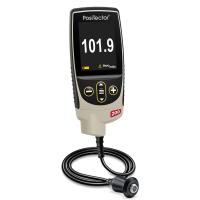
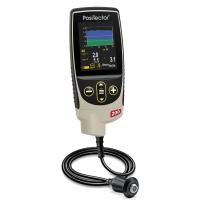
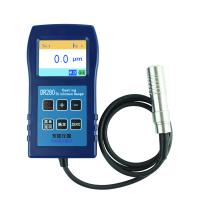
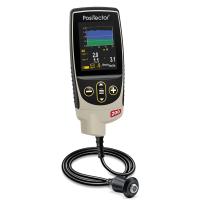
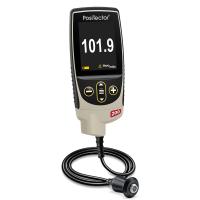
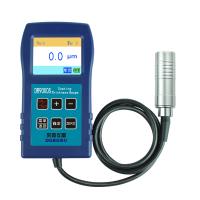
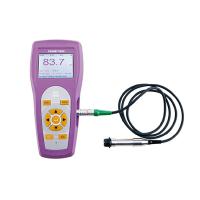
Today, a customer asked NBCHAO to measure the thickness of the coating on the main board. The main board is made of glass fiber, and the film thickness is required to be 0.06mm.

The first key point: choose the appropriate thickness measurement method
In this case, because its base material is non-metallic, he can only choose to use the ultrasonic principle instead of some methods such as magnetic induction or eddy current to measure. This is to consider the selection from the measurement principle.
The second important point: the measured area
Because the general sensor of the coating Thickness Gauge, which is what we usually call the probe, has a certain size limit. The ultrasonic probe is larger than the probe of the magnetic induction coating Thickness Gauge, and generally can reach a diameter of about three centimeters. Therefore, when using an ultrasonic coating Thickness Gauge to measure the coating on the main board, it is necessary to leave a free area, which is probably larger than the diameter of three centimeters, so that it is possible to put the probe down vertically, so as to measure Accurate data.
The third consideration is the thickness and precision of the coating.
Because the ultrasonic coating Thickness Gauge has a disadvantage compared to the Thickness Gauges of other detection principles, it has a minimum film thickness requirement when it measures. Taking Defelsko in the United States as an example, its minimum film thickness single-layer film thickness is more than 13 microns. In addition, the accuracy of the ultrasonic coating Thickness Gauge is also a relatively large disadvantage compared to the magnetic induction, which can probably reach ±3% .
Because the motherboard is generally a relatively flat plane, so there is no need to consider a problem of curvature. It is a pity that the detection of coatings, especially the detection of coatings on non-metallic substrates, basically as far as I know, only the American defelsko product can be tested. Other products, including all domestic ultrasonic Thickness Gauges, cannot remove the thickness of the coating.
Does that mean that ultrasonic waves can only be used to measure the coating thickness on non-metallic coatings?
In fact, smart people also thought of another way, which is to place a flat iron plate on the motherboard. When the spraying line passes through the iron plate, we use magnetic induction to measure the thickness of the sprayed coating on the iron plate, so that we can roughly know the thickness of the actual sprayed coating on the main board. Because this method has two advantages, one advantage is simplicity. The ultrasonic coating Thickness Gauge needs to be coated with coupling agent when measuring, but the magnetic induction coating Thickness Gauge can measure the coating directly. This is the first benefit. The second benefit is cost. Ultrasonic coating Thickness Gauges generally cost around 15,000, while magnetic induction coating Thickness Gauges are more selective. Imported thousands to tens of thousands. domestic. There are even hundreds of dollars. What is the difference in quality between domestic coating Thickness Gauges and imported Thickness Gauges? You can read some other related introduction articles on the NBCHAO Mall, so I won’t describe it here.
To sum up, when measuring the thickness of non-metallic coatings, especially dispensing coatings on the main board, one way is to use an ultrasonic coating Thickness Gauge. The second method is to cover the main board with a layer of metal iron plate, and then measure the thickness of the coating sprayed on the iron plate by magnetic induction method. Which method should you choose? One is which method is relatively simple or less expensive for technicians when selecting models. Second, if it is in the aspect of finished product testing, does the customer accept such a method? This is also about communication.