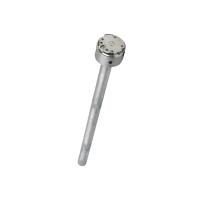
Catalytic diffusion sensors are common devices for detecting flammable gases and vapors. The prototype of this type of sensor is formed by winding a cable in a coil. The coils are then doped with two catalysts: one for the active element and one for the shielding element. The different coils described above are then matched to each set of reference and sensing elements. This is how the flammable gas sensor is formed.

The sensor is then placed in an electrical circuit where a fixed voltage is applied to both elements, causing them to heat up to a high temperature. The sensor is also connected to a balancing resistor (single-arm bridge), which detects the change in resistance of the sensor element. When a flammable gas comes into contact with the sensor, the activated element starts to burn the gas, heating it up. The reference element temperature remains constant because it cannot burn the gas. The heating of the activation element creates an imbalance in the circuit - interpreted as a positive burning signal.

Combustion occurs within the sensor compartment, so the sensor itself is designed to be safe and not a source of ignition when exposed to flammable atmospheres. Flame arresters can be used for this purpose. The device, usually made of sintered material, acts as a channel to cool the gas escaping the sensor. In terms of safety performance, only equipment that has been tested and approved by a third-party certification body (such as Underwriters Laboratories, Canadian Standards Association, Mine Safety and Health Administration, FM Corporation or CENELEC) is trustworthy.