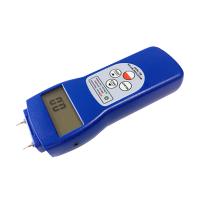
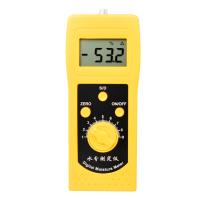
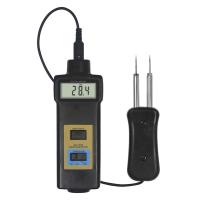
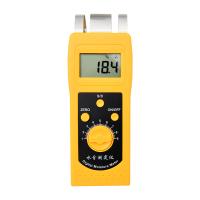
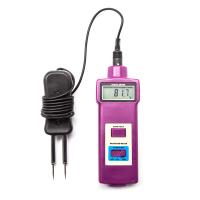
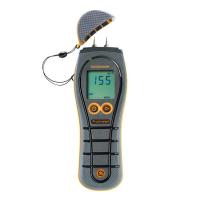
In many cases it may be necessary to test certain substances for their moisture content (%MC). Also, when it comes to directly testing the moisture content of materials, there are two main options - pin  Moisture Meters and pinless Moisture Meters.
Needle Moisture Meters use the principle of electrical resistance to measure the moisture content in various materials. Since water is a conductor and materials such as wood, cotton, plaster, and hay are resistors, the easier it is for electricity to flow through a material, the wetter it will be. For accuracy, it is important to ensure that the pin meter is calibrated for the specific material being tested - as different materials have different intrinsic resistances to current flow.
Pinless hygrometers, on the other hand, use electromagnetic radio frequencies to "scan" a sample of material for the presence of water. Fluctuations in electromagnetic waves are used to measure the amount of water in a sample. The accuracy of a pinless Moisture Meter is affected by the specific gravity (SG) of the material being scanned, so the meter needs to be calibrated to the SG value of that material. Specific gravity is a measure of the relative density of a material compared to another material (usually water).
Both pin and pinless hygrometers have their own unique advantages and disadvantages that may make them more or less useful for specific humidity testing situations. When should I use a needle Moisture Meter and when should I use a needleless Moisture Meter? Here's a broad spectrum of situations where one hygrometer may be better than another.
Test large, flat surfaces such as entire floors
Pinless Moisture Meters excel at quickly and efficiently testing large areas of structures for moisture. Simply push the scan plate into the floor, read, lift, and repeat the scan at another location. The scan board inspects large areas at a time, taking only a few seconds per inspection. This allows the user to quickly scan very large areas of the structure with relative ease.
Pin hygrometers, on the other hand, can only check for moisture in the small area between the contact pins. In addition, they need to dive deep into the material being tested for a comprehensive reading. This usually means more force is needed to penetrate the tougher material, increasing strain and risk of breaking the pin. Both the smaller test area and the extra effort contribute to the increased time and labor costs of measuring moisture over large areas.
Option: Pinless Moisture Meter
Testing for moisture in uneven surfaces and loose fill materials
Pinless hygrometers require full contact with a solid surface to provide accurate readings. The accuracy of a pinless hygrometer will suffer if the scan plate does not lie completely flat on the material being measured. Also, if the material being scanned is loosely packed (such as for insulation or hay), the meter may end up testing the moisture content of the air between the fibers of the material.
On the other hand, pin Moisture Meters can easily be used to test materials that are loosely packed or have uneven surfaces. What matters is the current in the material being tested - as long as there is a path for the current to flow from one pin to the other, the test is done. However, for testing moisture in fiberglass insulation, hay bales, etc., specialized electrodes may be required.
Option: Needle Moisture Meter
Test for moisture in materials you don't want to damage
Pinless Moisture Meters are sometimes called "non-intrusive" or "non-destructive" Moisture Meters because they do not have to penetrate the surface of the material being tested to obtain an accurate moisture content measurement. That's why many flooring professionals use a pinless hygrometer to test the humidity of their hardwood floors. With a needle-free meter, moisture levels can be assessed without damaging hardwood floors.
Pin hygrometers, on the other hand, need to penetrate the surface of the material for proper testing. In applications where the surface condition of the final product needs to be preserved, leaving pinholes, even small ones that tend to be filled or filled with epoxy, is often not desirable.
Option: Pinless Moisture Meter
Determining the moisture distribution across the plate
When pinless Moisture Meters scan a material for moisture, they provide an average reading of all moisture in the scanned area. This means that if a pocket of moisture is detected, you won't know how deep it is. Or, if the material samples differ in shell and moisture content, you won't be able to understand the difference.
Pin Moisture Meters - especially those that use insulated pins - are excellent at determining the distribution of moisture in circuit boards. With insulated pins, one can simply push the pins in a fraction of an inch, read the data, push them in another inch, read again, and keep repeating the process until the pins are fully inserted. The distribution of moisture in the lumber can be invaluable information to lumber dealers as it can help them determine how the wood is curing so they can adjust kiln conditions accordingly.
Option: Needle Moisture Meter
Other considerations to consider when choosing a Moisture Meter
Of course, there is more to choosing a Moisture Meter than just using a set of pins or a scanning plate (or both) to test the moisture content of materials. You also need to consider:
What is the humidity reading on the meter,
What is the humidity detection range of the meter?
Is it possible to store readings for future reference,
the accuracy of the meter (and how easy it is to verify accuracy),
Whether the meter is an analog or digital Moisture Meter model, and
How easy is the Moisture Meter to use.