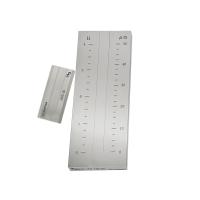
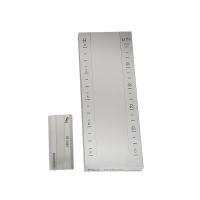
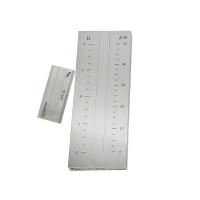
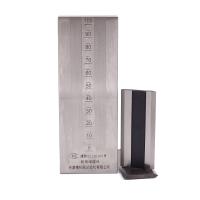
The scraper Fineness Meter is a measuring instrument used to measure the particle fineness of pigments, impurities and fillers in products such as clear (color) paint, ink and food, and can also be used to measure the particle fineness of similar substances. The scraper Fineness Meter is composed of a scraper and a scraper, and its appearance is shown in Figure 1 and Figure 2. The scraper has one or two inclined grooves parallel to the long side, with a given depth at one end and zero depth at the other end.

The straightness of the working edge of the scraper, the surface roughness of the scraper, the flatness and lateral straightness of the scraper, and the indication error of the scraper are the four major indicators for the performance inspection of the scraper Fineness Meter. The North and South Tide took you to explain in detail:
1. The straightness of the working edge of the scraper
The straightness of the scraper can be identified by the light gap method with the grinding surface ruler, and the straightness of the working edge of the scraper should be ≤2μm
2. Surface roughness of scraper
The surface roughness of the bottom plane of the scraper chute is ≤Ra0.4μm, which can be measured with a Surface Roughness Tester.
3. The flatness and lateral straightness of the scraper
Appraised with a knife-edge ruler, the flatness of the plane on the scraper and the bottom plane of the chute are both ≤3μm; the horizontal flatness of the plane on the scraper is ≤1μm
4. Indication error of scraper
Imagine the following if the groove meets the depth requirements, but what will happen if your indication value is marked off? Absolutely a pain in the ass! ! ! This is generally identified by an inductance micrometer, and this key instrument must be sent for inspection and measurement according to regulations, otherwise it is equal to nothing. As for the flatness, it can be compared with a miniature measuring table inductive micrometer for verification.

The indication error marked on the scraper shall not exceed the following regulations:
| Maximum depth of chute | maximum allowable error |
| 150μm | ±3.5μm |
| 100μm | ±2.5μm |
| 50μm | ±2.5μm |
| 25μm | ±1.5μm |
| 15μm | ±1.5μm |
In addition, in terms of appearance requirements, the upper plane and ground of the scraper, the working edge of the scraper and the surface connected to the working edge are free of defects such as rust, scratches, bruises, cracks, etc., and the working edge of the scraper should not exist. Obvious gaps, non-working edges should be chamfered, and other appearances are allowed without affecting the metering performance. Oh, right! In terms of materials, the scraper and the scraper should not be magnetic to prevent the interaction between the scraper and the scraper.
I want to make a lot of complaints here. There are messy bricks (thinness boards with special cut corners) on a familiar platform. The cheap ones are one or two hundred yuan, free shipping, and return and exchange for no reason! If you insist on tossing, I don't care! But don't ask why other people's prices are like this, and your price is like this. Beichao no longer compares these bricks with our fineness products one by one. What I can take the trouble to tell is: we have to make money, but we don't do evil things!