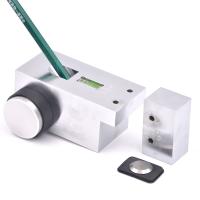
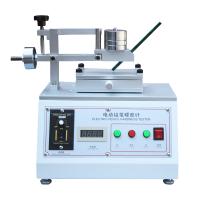
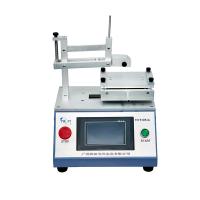
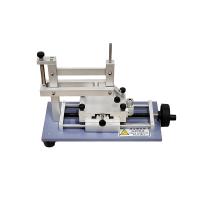
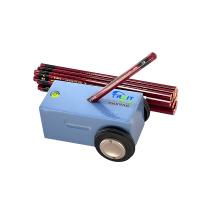
"Pencil Hardness" is a simple test that will tell you how hard the coating you are using is.

While some may consider it low-tech, using a pencil to test for hardness is still a method used by many paint manufacturers and some finishing shops. This test uses special pencils of varying hardness to scratch the coating and then determine its hardness. If you're not familiar with this test, you might be surprised by the comparative ratings of many coatings commonly used in wood finishing. Looking at the pencil hardness ratings of different coatings is one criterion that helps a woodworker decide which one to choose for a particular job.
The simplicity of the pencil hardness test is its great advantage. The special pencils used for the tests were made of various combinations of graphite and clay, baked in an oven to harden their combination. By adjusting the amounts of these two organic materials, pencils can be made either very soft or very hard. Pencil sets are available at most art supply stores or office supply centers.
A complete set will have the following pencil grades, starting with the hardest - 9H, 8H, 7H, 6H, 5H, 4H, 3H, 2H, F, HB, B, 2B, 3B, 4B, 5B, 6B, 7B, 8B and 9B (the latter being the softest pencil; it contains the most graphite and the least amount of clay). The "H" stands for "Hardness" and the "B" stands for "Blackness," which comes from the amount of graphite used in softer pencils.
A set of pencils, available at most art and office supply stores, can be used for a simple but accurate test to compare the hardness of various paints.
There is another pencil grading system that can be used, equivalent to grade B: #1 pencil is equivalent to B, #2 is the same as HB, #2-1/2 is F, #3 is H, and #4 is 2H. (Common writing pencils are #2 or HB grades, which are softer and leave darker marks when used for writing or drawing.
In order to prepare samples for testing, the wood should be sanded, clean and free of any dirt and dust particles. The coating should be between 1.0 and 1.5 mils thick (0.001 inches for a mil). After the sample is coated, it should be allowed to dry for 7 days before the pencil hardness test is completed. In some cases it may be useful to note when the test was completed along with the results.
The temperature of the environment in which the test is performed may affect the hardness of the coating as this may be a factor in drying time. Some coatings were harder after a week and, if retested, showed higher pencil hardness ratings after a longer period of time. If you really want to find out how hard the coating is, you can always repeat the test later on on the original sample. Better date and write with pencil hardness, then save the sample for future reference.
While the test itself is simple and easy, it gives uniform results and is reliable because the pencils are uniform in grading. With a small investment of time, you can accurately measure the hardness of a coating.
To test, simply choose a pencil and draw a line about 1 inch long on the wood sample. If the pencil leaves scratches, grab a softer pencil and do the same. The amount of the first pencil used after scratching in the coating without leaving a mark is considered the "pencil hardness" of the coating. (Some coatings are so hard that even a 9H pencil won't scratch them. All of these coatings have a 9H pencil hardness rating to indicate how hard they are.
Shown below is a list of pencil hardnesses for some of the different common coatings. This information comes from various manufacturers and some tests I did myself. It can be used as a general comparison.
Knowing the pencil hardness of a chosen coating can be useful information to pass on to customers - if they want a coating with a low pencil hardness, then they should be advised to take extra care of their furniture, as these low rated coatings will be more sensitive than the pH Higher coatings wear, scuff and scratch faster. (But even if the coating used has a higher rating, care should still be taken with all coatings, as no coating will not be damaged.
Using a pencil hardness test can also be used to compare products from different manufacturers. For example, one company's polyurethane may have a pencil hardness of 3H, while polyurethane from another supplier may be different. I suggest you do your own testing to see the true hardness of the brand of paint you are using.
Of course, the hardness of any coating is only one of its characteristics. Sometimes using a softer coat may be more beneficial to the overall performance of the finish. For example, in some applications, the ability of the softer coating to flex with normal orgasmic shrinkage and wood expansion, caused by changes in weather and temperature conditions, is preferable.
In addition to the hardness of the coating, there are other factors that can be tested that are equally important. These include: Abrasion Resistance, Reverse Impact Resistance, Direct Impact Resistance, Cross Hatch Adhesion, Oxidation, Gloss Retention, Yellowing, Blistering, Cold Check, Dry Time, Chemical and Solvent Resistance (use rubbing and point time test), salt spray resistance, VOC and HAPs content, moisture resistance, acid resistance and corrosion resistance.
Most paint formulations are for specific types of finishes, various conditions or different substrates. Therefore, the pencil hardness test was used as a criterion for selection. However, don't judge any coating by pencil hardness alone, as there are many other important properties to consider.
Pencil hardness paint for common paint
Type: Pencil Hardness
Catalytic polyester: 9H
Catalytic polyurethane: 9H
Catalytically modified acrylic polyurethane: 4H
Catalyzed Acrylic Urethane: 2H
Waterborne polyurethane: 3H
Waterborne urethane/isocyanate catalyst: 2H
Conversion Varnish: 4H
Low-VOC paint: 3H
Low VOC catalytic paint: 2H (24 hours)
Urethane/Nitrocellulose Lacquer: F (24 hours)
Water dilutable paint: 2H
Tung Oil/Polyurethane Wipe Finish: 2H
Waterborne Polyurethane Wipe Finish: HB-F Precatalyzed
Aerosol: 3B water
Clear acrylic aerosol: 3B
Transparent shellac aerosol: 3B
Polyurethane/nitrocellulose aerosol: HB
Nitrocellulose Aerosol: 3B
Amber (orange) shellac 1 lb cut (waxed): 3B