The world of color measurement is rapidly evolving and it can be difficult to judge the quality of the many color Measurement Instruments on the market. Some instruments are standalone, some offer compatible apps and cloud storage, and many are attractive purchases, promising low price points and color-matching features.
While there are many device specifications to consider, there are 5 key specifications that directly impact color measurement performance.
1. Inter-instrument protocol is key, not only to measure color but also to communicate - especially in complex supply chains. Inter-Instrument Agreement (IIA) measures how similar two or more identical devices (eg: two Color Muses) can measure the same color. This can be an important parameter for measuring the color of communication with two devices between different sites. It's like speaking the same language but with a different accent. If the accent is too loud, two people cannot communicate. For color measurements, it is generally accepted that humans on average cannot distinguish colors below 1.0 dE2000. In my opinion, a color measurement device that averages over 0.5 dE2000 in a real world IIA of thousands of colors is useless for any use beyond finding color inspiration. This is because the two devices are actually talking about different colors, even though they are scanning the same color. Any small drop in IIA translates into a big improvement in color matching, since the uncertainty between the two is much tighter. To me, an average IIA of less than 0.2 dE2000 would produce a fleet of instruments capable of distinguishing and communicating even closely spaced whites (~0.7 dE) used in many architectural paint colors.
2. The stability or repeatability of the instrument is an important consideration. The stability of a color measurement system is made up of many factors; how the light source degrades over time, the overall mechanical stability, how plastics and organic materials age, and how efficiently the temperature converts photons to electrons in the Detector. In my opinion, a repeatability of less than 0.1 dE2000 is adequate for general color matching.
3. For 45/0 optical geometry, the importance of peripheral illumination to minimize directional shadows cannot be overstated. It is not enough to light the surface from two directions in the 45/0 geometry. This is most noticeable in textured surfaces, where two directional lights will read colors differently depending on how the instrument is placed on the surface. NOTE: Other optical arrangements such as d/8, d/0, multi-angle may be suitable for specific applications.
4. Full-spectrum illumination allows the eye to see all wavelengths of the visible spectrum. If the illumination has large peaks and missing wavelengths, spectral features in those regions where the illuminated wavelengths are missing can create inaccuracies in color measurements. The use of LEDs in color measurements can be tricky because many LEDs do not have full-spectrum illumination and the 400-440 nm is often missing from LED sources. When considering color measurement equipment, full-spectrum illumination from 400-700 nm will improve color measurement at the edges of the measurable color space.
5. Prefer the reflectance curve of a Spectrophotometer over the laboratory color of a Colorimeter. One of the main advantages of reflectance curves is the ability to measure color under different lighting. For a Spectrophotometer , look for the color reflectance curve output in 10 nm increments. While instruments may exist that measure in 30-40nm increments, this is not sufficient from an industry standard perspective, as larger increment sizes lead to inaccuracies when sharp spectral features are present. Most color databases and software use 10 nm increments, and conforming to this standard also saves time and money.
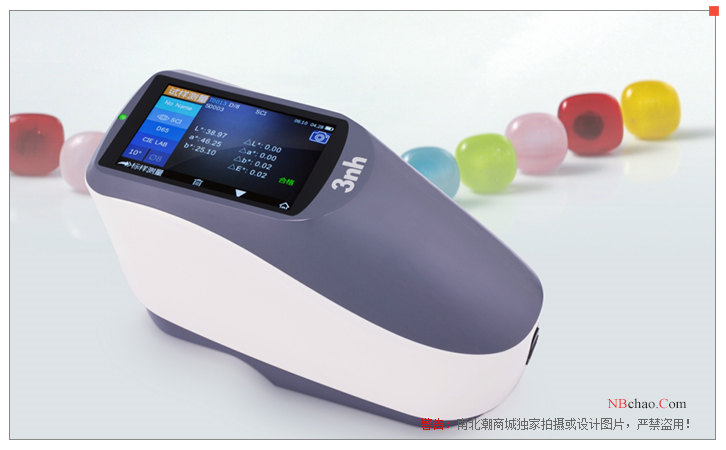
As color measurement methods become more specialized, and device offerings vary in the consumer market, these are the most convincing and reliable ways consumers and color professionals can evaluate device performance.