Over the past hundred years, the coatings industry has moved from science to science. Today, coating technology uses chemical, physical and engineering sciences. New technologies provide new materials, new production equipment, processes and substrates. Unfortunately, growth always brings a certain number of problems.
Today's paint systems are often so complex that our techniques are so specialized that they can ignore the exact nature of the problem. The cause of the problem is often thought to be chemical, when in fact it may be physical.
Poor color strength or hue, as well as other properties such as opacity, transparency or gloss, are often blamed on off-spec pigments. Many problems are not due to chemical reactions or poor raw material quality, but to particle size distribution.
The following properties depend on granularity:
flocculation
Hue/Tint Intensity
hidden/transparent
Gloss/flat and film appearance
viscosity
stability
weather resistance
The extent to which these properties can be optimized is related to the method of dispersion used, the energy of expansion on the solid particles and the length of time the pigment particles are subjected to the energy of dispersion.
Flocculation, tinting strength, hue and transparency
Paint chemists describe a variety of color-related problems arising from numerous mechanisms such as flocculation. Common examples are paints and colored pigments pigmented with titanium dioxide, especially organic pigments, which develop more color when the applied wet film is subjected to additional energy.
Typically, this type of effect occurs when a white base is colored with a dispersion of organic or colored pigments. If the resulting mixture shows a color change due to additional shear, the usual conclusion is that the organic pigment dispersion has flocculated or is flocculated in the white tint base due to a chemical deficiency in the stability of the organic pigment. Dispersion or incompatibility between pigment dispersions and white tint bases. In fact, friction often occurs because the organic pigment particles are not sufficiently deflocculated when initially dispersed. Organic pigments, as received, are in a flocculated state. High speed mixing equipment does not have enough power to break up even loosely packed organic pigment agglomerates. So if we add dry, colored organic pigments to a white colored substrate, the resulting finish will not only be grainy, but rubbing will show huge differences in color development. Tribological testing, while harsh, subjects the coating to considerable energies, even higher than can be achieved with high shear dispersions.
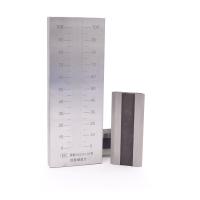
This is a very rough example and we all know that these organic pigments need to be pre-dispersed to get the desired results. However, many of our questions were related to the fact that we identify pigment dispersions by correlating them to a given Hegman grind reading.
While useful, the Hegman color of a grind plate is often misleading. The Hegman fineness of grind scale only indicates the size of the largest particles in the dispersion. It does not indicate the particle size distribution. The deflocculation state of a pigment is related to the particle size; in order to obtain very good results without friction or deflocculation, the pigment needs to be dispersed as close to its final particle size as possible.
Tests performed on quinacridone violet showed that as the particle size decreased, the amount of friction observed when tinting a white substrate decreased, as shown in Figure 1 (right). In Figure 1, the degree of friction is indicated on a scale of 1 to 10; 10 severe and one no friction.
color intensity
To further illustrate the effect of particle size reduction on quinacridone violet, disperse at a Hegman fineness of 7 NS. This is the point where most paint chemists and production people stop if they want to paint enamel with a Hegman abrasive that has 7 NS; and also involves 7 3/4 NS, or nearly off the gauge. The two dispersions were then used to color white enamel and a comparison of rubbing, tinting strength and hue was carried out. The resulting comparison showed that the 7 NS dispersion rubbed significantly and also had a 15% reduction in tint strength.
Transparency and Tint
When comparing these same two dispersions in transparent films, large differences in transparency and hue were observed. These differences are very important when making metal coatings. When these two dispersions are used to make metallic paint finishes, the results are remarkable. The paint prepared with the 7NS dispersion exhibited poor metal triggers, a matte, bluish wash-out film and low gloss that was 3/4 greater than the paint made with the 7 dispersion.
Micrographs of the transparent films show clear differences in particle size distribution. Additionally, the actual particle size distribution using a Coulter counter showed an average particle size of 6 microns for the 7 NS dispersion, and 0.5 microns for the 7 3/4 sample.
The fact that most organic pigments undergo these dramatic changes in hue, shade intensity and transparency is not a new concept. Many paint manufacturers sacrifice extra strength to avoid running longer grind cycles or buy better equipment, not realizing that giving up 10% of strength can be expensive. Also, the final quality of the final product is sacrificed. Friction, clarity, transparency and brightness in metals, among other properties, cannot be achieved unless the pigment particles are reduced close to their final size.
hide
Just as clarity depends on particle size reduction, hiding power depends on particle size. However, in the case of concealment, the particle size needs to be controlled within a given range.
Titanium dioxide is specially processed to a particle size of 0.20 to 0.35 microns, or about half the wavelength of light. By dispersing the pigment to its fine size, the ultimate hiding power can be obtained. Still other inorganic pigments are opaque by design. In general, the finer the particle size, the higher the possible opacity.
Inorganic pigment manufacturers have improved the dispersibility of synthetic oxide pigments such that they now facilitate agitation or easy dispersion of many pigments, meaning Hegman 6 NS or better can be achieved with high speed dispersing equipment. While this is certainly true, hiding power is often sacrificed.
Typically, these pigments are red and yellow oxides. To illustrate the effect on hidden particle size, several oxide pigments were used with both high speed dispersion to 6+ NS Hegmans (25 microns) and small media grinds to 7 dispersions of 1/2 NS Hegmans (6 microns or more Small). In most cases, an increase in hiding power is noted when the particle size is reduced to the approximate average size of the synthetic pigment crystals. When the results were compared, it was found that to achieve equal hiding power, as much as 15% pigment was required, with the dispersant milled to only 6+NS.
As the yellow oxide disperses further, significant color shift occurs, resulting in dirtier colors and loss of hiding power. Severe discoloration indicates cracking or destruction of the original pigment particles.
When the synthetic iron oxide pigment is dispersed to 6 1/2 NS Hegman (20 microns), the expected dark red oxide or maroon-like shade is obtained. However, on further dispersion of these grades, not only is there a marked improvement in hiding power, but the quality tint and tint both shift to a mid-red iron oxide hue. The pronounced hue shift is due to the destruction of individual pigment crystals, except that in this case the pigment particles have been reduced to the size of the next finer red iron oxide production stage.
While there are other parameters that contribute to hiding power, controlling particle size not only produces great hiding power, but also reduces costly reprocessing due to unwanted color shift.
extinction
In trade sales as well as in many industrial coatings, various additives are used to control gloss. These materials include silica and other extender pigments in clearcoats or varnishes, such as clay, talc and carbonates in coloring systems. While it is well known that the diameter of solid particles or pigments in a given coating needs to be smaller than the expected dry film thickness of the coating, many people do not realize that accurate particle size control is important when using silica to reduce gloss.
A batch of satin varnish was reported to have a gloss level of 10 units too high; and, after adding silica to correct it, was 15 units too high?
Table I - Glass Rates and Particle Sizes
Silica particle size, in microns Gloss of varnish
35 20
25 30
16 42
6 60
The reason is that when grinding in silica, the silica already present in the system is ground, resulting in a loss of planarization efficiency. Table I shows the gloss of several varnishes of identical composition, except that the silica-leveling additive was dispersed to different particle sizes.
Flatness, transparency and gloss all depend on diffuse reflected light. Once the leveling additive is reduced beyond a given particle size, the film surface becomes more uniform. This allows more reflected light at an angle of incidence equal to the angle of reflection; thus, glossiness goes up.
luster. Since reducing particle size reduces flattening efficiency, it is natural to assume that it favors gloss. The particle size of the pigment in the coating affects the smoothness of the film and causes light to scatter (Figure 3).
Earlier, two Quin-acridone Violet dispersions dispersed into different particle size ranges were shown to produce differences in color brightness. Additionally, those with larger particle size violet pigments resulted in about 10 gloss units lower. When attempting to produce jet black massstone gloss paints, the blackness of the resulting paint depends on achieving the final particle size distribution, especially since the blackest carbon blacks may have the smallest particles (approximately 0.07 microns) of all pigments.
Movie look. Finer particle size will result in better clarity and gloss, due in part to the smoothness of the film. In many coatings, especially industrial coatings, various waxes, polyethylene and other special hard polymers are used to impart certain properties to the cured film. These properties include a lower coefficient of friction, improved mar and abrasion resistance, and reduced metal marking. This can be achieved without adversely affecting other properties such as recoatability, adhesion, gloss or shrinkage. Since these materials function by reaching the surface of the cured film, many of their beneficial and detrimental effects depend on particle size.
Since these particles act on the surface of the membrane, it is clear that the larger the particle, the greater the effect on the uniformity of the membrane. This is especially true in baked coatings, where these particles become liquid during the bake cycle. In their molten state, they are generally incompatible with the resin and/or carrier system of the coating. Therefore, the smoothness of the membrane is affected by the difference in surface tension of the two liquids.
Figure 3 (right panel) shows what happens in coatings containing large polyethylene particles at various stages of film formation. After coating and before baking, the solid polyethylene particles near the surface produced a slight disruption of film smoothness and thinned the paint film wall above it by drainage.
在烘烤过程中,聚乙烯熔化并变成液体。由于表面张力的差异,聚乙烯将使涂料液体从聚乙烯液滴中挤出,形成凹坑。在干燥和冷却后,聚乙烯液滴回复到固体,并且在经历一些收缩的同时,保持为球状。
当然,颗粒越大,陨石坑越大。这会影响透明涂层的薄膜完整性,透明度和光泽度,以及着色涂层中的反射图像。通常,这可以通过减小粒度来控制,这不仅减少了膜的缺陷,而且还增加了所用添加剂的活性。
流变性和稳定性。油漆生产通常使用预分散的颜料浓缩物,无论是在室内生产还是从外部供应商处购买。因为这些浓缩物用于各种化学上不同的涂层,所以天然需要广泛的相容性。
为了达到这种效果,这些浓缩物的制造商试图使配方尽可能简单,以防止由于使用不必要的添加剂而产生的不利影响。另外,这些色母料通常长时间保存在库存中,因此需要显示出良好的储存稳定性。
许多油漆化学家认为有时候应该使用添加剂以防万一。一个例子是流变改性剂或增稠剂和抗沉降剂。通常这是在没有清楚地了解添加剂是否真的必要的情况下完成的; 其他方法来达到要求的结果; 或者对老化有什么不良影响。
对于预分散的色母料,需要两种类型的稳定性:1)耐老化稳定性; 2)老化时抗絮凝性。
在引入可能对耐水性,宽范围相容性,絮凝,流动和流平等性质产生不利影响的添加剂之前,应评估的第一个参数是作为粒度函数的分散稳定性。
通过以下三种方式减小粒度来改善颜料分散的稳定性:
流变学和/或粘度。减少颜料粒径会增加颜料表面积,这通常会导致粘度增加。而且,许多有机和甚至无机颜料体系都具有触变状态。较高的粘度或诱导的触变性可防止颜料流动,防止沉降和再絮凝。
预防絮凝。在絮凝中,颜料颗粒倾向于再附聚,导致颜色强度损失和颜色均匀性差。减小颗粒尺寸将防止再附聚。减小粒径会增加系统的粘度; 它进一步降低了迁移的可能性。
沉降。大多数涂料制造商的主要稳定性问题之一是解决问题。颗粒尺寸的差异可以在液体介质中沉降球形物体时显示出广泛变化的结果,并将其应用于分散体或涂层体系中颜料颗粒的速率或沉降。由于简单的粒径减小,我们可以看到稳定性获得的值。
粉化,耐光性和耐候性。除了包装稳定性之外,固化膜的稳定性或涂布和固化后涂层的性能可受颜料粒度的影响。
不透明涂料需要各种颜料,这取决于它们的选择,会影响涂料性能。在许多情况下,颜料的选择基于美学或经济价值,并且很少考虑其与所需涂层性质或粒度对这些性质的影响的实际性质。
对于边缘性质的体系,粉化,耐光性和光泽保持性可能受到粒度减小的不利影响。用通用级二氧化钛与分散到不同粒度范围的合成红色氧化铁和黄色氧化铁颜料组合进行的简单实验导致耐水性,光泽保持性和粉化的显着差异。一些边界颜料的耐光性也同样受到粒度分布差异的影响。
为了显示这些效果中的一些,制备基于完全相同的载体类型和颜料比的釉质并将其分散到不同的粒度范围内。在一种情况下,颜料由2:1比例的二氧化钛和黄色氧化铁组成; 在另一种情况下,二氧化钛和红色氧化铁的比例为2:1。
以两种颜色制备涂料,其平均粒度范围为25微米和6微米。如所预期的,更细的粒度在未曝光的板中产生更高的光泽度。如表II所示,500小时的QUV暴露导致表观光泽和颜色变化
粒径的减小导致颜料表面积的增加。因此,颜料减少到6微米的涂层将有更多的颜料暴露在表面上,具有较少的载体以防止变质。由于二氧化钛的粉化速度比铁氧化物快,因此老化时强度明显下降。在洗涤曝光区域并将其与未曝光区域进行比较后,结果显示两个表面具有相同的光泽度和颜色,表明上述数值结果的变化严格地归因于粉化。这些结果是通过使用通常预期会发白的颜料组合获得的。选择对粉化更具抵抗力或对光不太敏感的颜料会降低所示的效果。然而,
Coatings with a finer particle size distribution range show significantly better water resistance. The reason for this can be explained by the fact that, in these experiments, the pigment combination was intentionally selected from those pigments that were likely to be more hydrophilic. In Figure 4 (right panel), which schematically represents two coatings containing different particle sizes, we can see that larger particle sizes tend to provide a wicking effect by which moisture can travel to the substrate. This leads to blistering, softening and eventual failure of the coating and corrosion of the metal substrate. Although we have advanced very well in polymer technology, providing us with coatings that beautify, protect, insulate and even react with a given substrate,