Two common Spectrophotometer s are 0:45 and sphere (aka diffuse/8°). We get a lot of questions about which is a good choice. Here's how the two devices measure color differently, and guidelines for when to use each.
0:45
In a "fixed geometry" or "single angle" setup, the first number is where the light starts and the second number is where the light finally ends after reflecting off the sample surface. In the 0:45 instrument, the light source is fixed at 0 degrees and the Detector is set at 45 degrees. In 45:0, the light source is set at 45 degrees and the Detector is set directly on top of 0 degrees.
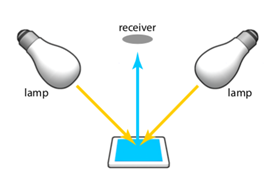
0:45 is ideal for measuring color on smooth and matte surfaces as it captures the reflection of the sample as seen by the human eye. While it is possible to use it to measure glossy or reflective surfaces, it does not include surface appearance and can cause samples to measure darker and more saturated than they actually are.
For example, say you have two black swatches, one matte and one glossy. Although they are the exact same black, when measured with 0:45 the data will not match. Glossy samples will appear darker and more saturated, while matte samples will appear lighter. This is due to the difference in direct reflection (glossy samples) versus diffuse reflection (matte samples).
ball
The interior of a spherical Spectrophotometer is actually spherical. By using a baffle for the light source and reflecting it off the pristine white matte surface inside the sphere, the Detector receives the reflected light at an 8-degree angle from the object's surface to accurately measure color.
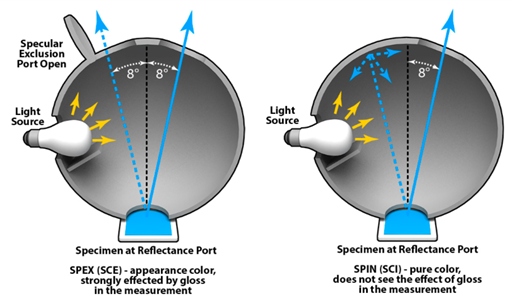
One of the key points of the spherical setup is its ability to measure in specular (SPIN, SCI) or specular (SPEX, SCE) conditions. The inclusion of specular reflections cancels the effect of specular reflections off the surface, which means it only measures color - not appearance. Specular exclusion includes surface appearance in measurements.
As an example, let's go back to our two black samples, glossy and matte, if measured using a sphere containing the specular surface, the resulting measurements should be similar. If you measure them using specular to exclude them, the numbers will be farther apart, something like 0:45.

