Coating on Substrate
Coatings are usually very thin layers of material supported by a substrate. Anything that is placed on top of a substrate is a coating, which includes waxes, lacquer/acrylic/enamel paints, and other types of materials that coat a substrate. Coatings applied to hard substrates will naturally increase the hardness of the coating.
What is hardness?
Hardness is the resistance of a solid material to deformation when a compressive force is applied. Some materials, such as metal, are harder than others, such as plastic. Macroscopic hardness is usually characterized by strong intermolecular bonds, but the behavior of solid materials under force is much more complex; therefore, there are different measures of hardness:
1) Scratch hardness
2) Indentation hardness
3) Rebound hardness.
Hardness is highly dependent on ductility, elastic stiffness, plasticity, strain, strength, toughness, viscoelasticity and viscosity.
Scratch hardness
In this article, we will zoom in on Scratch Hardness. This test is used to determine a material's hardness against scratches and abrasions.
There are generally 3 scales used to determine mineral hardness:
Mohs Scale: It is based on relative scratch hardness, with talc assigning a value of 1 and diamonds assigning a value of 10. The Mohs scale has two limitations; it is not linear and most modern abrasives are between 9 and 10 .
Ridgway's Scale: Changes the Mohs hardness by giving Garnet a hardness of 10 and Diamond a hardness of 15.
Wooddell's Scale: Extending Ridgway's Scale using Abrasion and extrapolating the Scale from Quartz's 7 and Corundum's 9 gives a South American brown diamond with a bort value of 42.4.
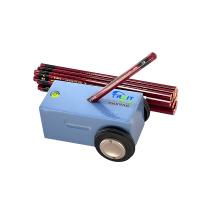
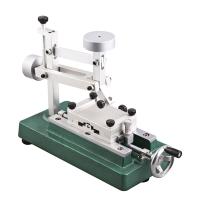
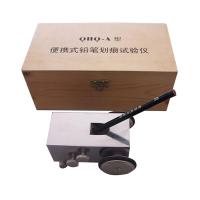
pencil hardness
Mineral scales (Mohs, Ridgway and Wooddell) are less suitable for use with paint or film. Therefore, a standardized ASTM method for measuring thin films using the pencil hardness scale was created. Pencils are made of graphite with a Mohs hardness of only 1-2H. Think of the pencil hardness scale as a detailed hardness scale for graphite.
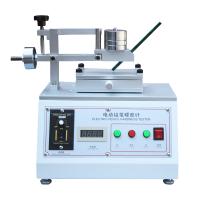
For many years, the coatings industry has used pencil hardness measurements to determine the hardness of clear and pigmented organic coating films. This test method has also been used to determine the cure of these coatings, especially when forced drying using heat.
This test method is especially useful in development work and production control testing in a single laboratory. It should be recognized that the results obtained may vary between laboratories when different pencils and panels are used. Every effort should be made to standardize the hardness of the lead used and the technique followed.

It is also important to note that the pencil hardness test is only one of many tests used to evaluate coatings. The hardness of any coating is a consideration, so don't judge a coating solely on its hardness.
Graded pencils come in a variety of hard and soft and can be found at most art or office supply stores, ranging in hardness from 10H to 9B. 'H' stands for hardness, 'B' stands for black, and HB stands for hard pen and black pencil. Hardest is 10H, then 9H, 8H, 7H, 6H, 5H, 4H, 3H, 2H and HF is the middle of the hardness scale; then HB, B, 2B, 3B, 4B, 5B, 6B, 7B , 8B and 9B, which are the softest. A commonly used writing pen is #2 (Grade HB), which is quite soft, contains more graphite, and leaves a dark mark. IGL Coatings Kenzo is rated at 10H.


How to take a pencil test?
Typically, coating thicknesses of 25.4-38.1 microns were tested and allowed to dry for 7 days. Ambient temperature during testing may also be a factor in drying time and may have an effect on the hardness of the coating.
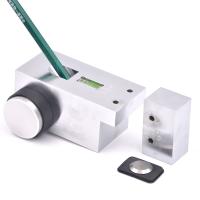
Pick a pencil and make a line about 1/2 inch long. If the pencil scratches the coating surface, then use softer pencils until we get the first one that doesn't scratch the coating.
Repeat the test to ensure that the results are reproducible. There are also some coatings that are so hard that a 10H pencil won't scratch them - these are rated 10H, which indicates how hard they are.
Use this chart as a guide only. It is also important to understand that the hardness of any general-purpose coating may not always be the same; in other words, if one company has a polyurethane with a hardness of 3H, do not assume that all other polyurethane reinforcements have a hardness of 3H. They won't; they vary by manufacturer and product.
As mentioned above, the pencil hardness test is just one of many tests used to evaluate coating performance. Other tests like Abrasion Resistance, Reverse Impact Resistance, Direct Impact Resistance, Cross Hatch Bonding, Oxidation, Gloss Retention, UV Resistance, Yellowing, Blistering, Dry Time, Chemical/Solvent Resistance, Salt Spray Resistance Resistance, moisture resistance, acid and alkali resistance, VOC and HAP content, etc. are also very important to the performance of the coating.