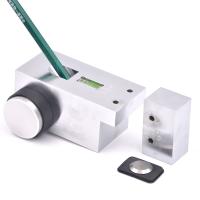
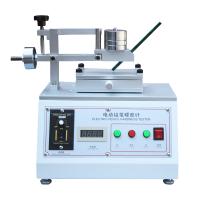
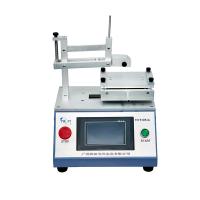
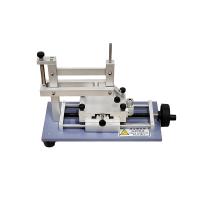
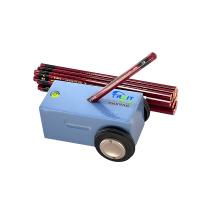
After performing the "pencil hardness" test on various coatings, I was amazed at the results I got. Thought I'd share this information with those who might have an opinion on what they consider tough and durable paint. I want you to know from the start that the pencil hardness test is just one of many tests used to evaluate coatings. Obviously, the thing to consider is the hardness of any coating, so don't judge a coating entirely on the basis of this test.
The test is very simple, gives uniform results, and is reliable because the pencils are graded. The grade of a pencil is determined by the amount of calcined graphite and clay in its composition.
Graded pencils come in a variety of hard and soft varieties and can be found at most art or office supply stores. My set consists of twelve pencils ranging in hardness from 4H to 6B. 'H' stands for hardness, 'B' stands for black, and HB stands for hard pen and black pencil. The hardest is 9H, followed by 8H, 7H, 6H, 5H, 4H, 3H, 2H and HF is the middle of the hardness scale; then HB, B, 2B, 3B, 4B, 5B, 6B, 7B, 8B and 9B, which is the softest. Another scoring method uses numbers; the equivalent is #1 = B, #2 = HB, #2-1/2 = F, #3 = H, #4 = 2H. A commonly used writing pen is #2 (Grade HB), which is quite soft, contains more graphite, and leaves a dark mark.
To perform your own pencil hardness test, always use dry, clean, well-sanded wood.
| paint type | pencil hardness |
| Catalyzed polyester | 9H |
| Catalyzed Polyurethane | 9H |
| Catalytically Modified Acrylic Urethane | 4H |
| Catalyzed Acrylic Urethane | 2H |
| Waterborne Polyurethane | 3H |
| Waterborne Urethane / Isocyanate Catalyst | 2H |
| conversion varnish | 4H |
| Low VOC catalytic paint [24 hours] | 2H |
| Low VOC paint | 3H |
| Urethane/Nitrocellulose [24 hours} | f |
| water dilutable paint | 2H |
| Tung Oil/Polyurethane Wipe-Off Finish | 2H |
| Waterborne Polyurethane Wipe Finish | HB-F |
| Aerosol prefabrication | 3B |
| Aerosol Water Clear Acrylic | 3B |
| Aerosol Clear Shellac | 3B |
| Aerosol nitrocellulose/polyurethane | HB |
| Aerosol nitrocellulose | 3B |
| Amber (orange) shellac 1 lb. cut | 3B |
Typically, coatings are tested at a thickness of 1.0-1.5 mils (a mil is one-thousandth of an inch) and have been allowed to dry for 7 days. In some cases, different drying schedules were used and the diagram shows the drying schedule in parentheses. Ambient temperature during testing may also be a factor in drying time and may have an effect on the hardness of the coating.
Choose a pencil from your set, and make a line about 1/2 inch long. If the pencil you start with scratches the surface of the coating, then go down the pencil grades until you find the first pencil that doesn't scratch the coating. Redo the test, and if you get the same result, you have determined the "pencil hardness" of the coating you are testing. It's that simple. Some coatings are so hard that a 9H pencil won't scratch them - all of these coatings have a 9H rating to designate their hardness.
Use this chart as a guide only. It is also important to understand that the hardness of any general-purpose coating may not always be the same; in other words, if one company has a 3H hardness for its polyurethane, do not assume that all other polyurethanes have a 3H hardness. They won't; they vary by manufacturer and product.
As I mentioned before, the pencil hardness test is just one of many tests used to evaluate the performance of a coating. Other tests include abrasion resistance, reverse impact resistance, direct impact resistance, cross-hatch adhesion, oxidation, gloss retention, UV resistance, yellowing, blistering, dry time, chemical/solvent resistance (using rubbing and spot / time test), salt spray resistance, moisture resistance, acid and alkali resistance, VOC and HAP content, etc.