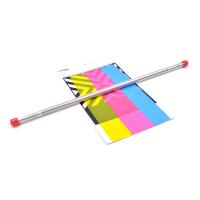
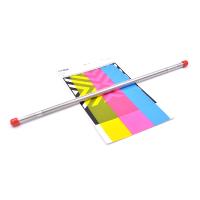
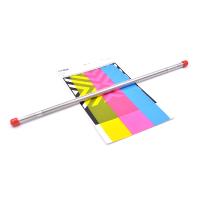
Applying butter with a serrated edge cutter has always been a good analogy to help explain how a wire wound or formed stick works. The butter squeezes in the cavity between the base material and the wire wrapped around the rod, and flows out in hills and valleys, then in a smooth flow. (if the butter is warm) If we could look at a cross section of hard butter we would see something like the image on the right.

The area of each groove is .000061 square inches. This is theoretical. What happens in real life is that some coating is left at the bottom of the gaps between the wires.
So if the butter is warm it will flow and we have a perfectly flat even coating. The thickness of the coating made from the rod is about 9% of the wire diameter. So a #10 rod is 0.010 inches or 10 mils and will give you 0.9 mils of coating. Cardstocks are available including wet film thickness and dry coat weight. Later we'll talk about our formulated butter and what happens if it's not warm enough.


coating head
Now that we know how the rod works, we'll learn how to get the coating on the net. The picture below is a typical Kiss Roll configuration. Here the network moves from left to right. The pan is filled with the coating and the pick-up or applicator roll is rotated relative to the web to deposit the coating on the web. "Lifting fingers" also known as edge positioning plates, are metal or plastic used to lift the web off the roll and keep the edges of the web clean as the roll, due to its helical winding, spreads the coating to one side.
A good arrangement is where the pinch roller can act independently so that the operator can vary the wrap around the applicator roller or rod. Operators also need to be able to change the direction of the applicator roller.