Film Hardness - Pencil Test - ASTM D3363
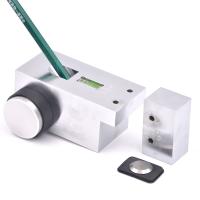
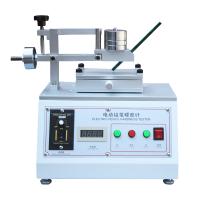
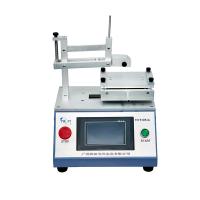
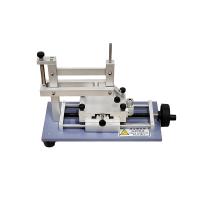
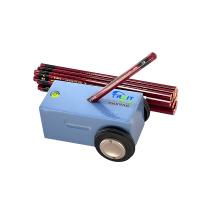
Test method ASTM D3363 covers a procedure for the rapid and inexpensive determination of film hardness of organic coatings on substrates from a lead wire or pencil lead of known hardness.
Place the coated board on a firm level surface. The pencil rests firmly on the film at a 45º angle (away from the operator) and pushes away from the operator at a distance of 0.256 inches. (6.5mm) stroke. Begin the process with the hardest pencil and continue along the hardness scale to one of two endpoints; one, the pencil will not cut or goug the film (pencil hardness), or two, the pencil will not scratch the film (scratch hardness ).
ASTM D3363 is especially useful in individual laboratory development work and production control testing. It should be recognized that the results obtained may vary between different operators and laboratories. Every effort should be made to standardize the hardness of the lead used and the technique followed. If used as the basis of a purchase agreement, this test method will achieve maximum precision if there is agreement between the buyer and seller on a given set of referee pencils.
Reference: ASTM D3363 Standard Test Method for Film Hardness by Pencil Test
Tukon Hardness/Microhardness (ASTM D 1474)
"Standard Test Method for Indentation Hardness of Organic Coatings"
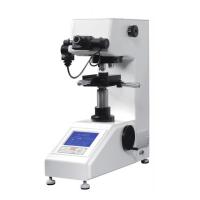
ASTM D1474 covers the determination of the indentation hardness of organic materials such as dry paints, varnishes, and lacquer coatings when applied to an acceptable planar rigid surface such as metal or glass.
These determinations require a Hardness Tester consisting of a load applicator, a Knoop indenter and a microscope with a movable micrometer stage. A Knoop indenter is a pyramid-shaped diamond that is given a hardness value based on the Knoop Hardness Number (KHN).
As it is used for organic coatings, a load of 25 g is applied for 18 s, after which the indenter is removed from the coating and the length of the long diagonal of the remaining indentation in the coating is measured and converted into a KHN measurement.
In addition to optical microscopy and SEM techniques, other information about the coating can be evaluated. Coating adhesion, coating uniformity and coating defects such as porosity and inclusions can be evaluated. In the case of metallic coatings, intermetallic compounds such as the brittle iron/zinc layers that form in galvanized steel can also be analyzed.