Photoionization Detectors (PIDs) have proven to be a satisfactory solution for monitoring benzene in the environment. But there are several factors to consider when choosing an instrument.
PID operation theory
Figure 1 is a schematic diagram of a typical PID sensor system. The UV lamp produces high-energy photons, which enter the sensor chamber through the lamp window and mesh electrodes. The sample gas is pumped over the sensor, about 1% of which passes through the porous membrane to the other side of the sensor chamber. The inset at the "bottom right" in Figure 1 shows what happens at the molecular level. When a photon of sufficient energy strikes the molecule M, an electron (e-) is ejected. The M+ ions travel to the cathode and the electrons travel to the anode, creating a current proportional to the gas concentration. Current is amplified and displayed as ppm (or parts per billion (ppb)) concentration. Not all molecules can be ionized, therefore, the main components of clean air, i.e. Nitrogen, Oxygen, Carbon Dioxide, Argon, etc.,
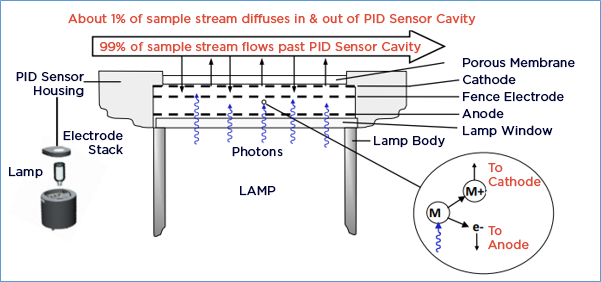
Figure 1: Ion Science Ltd PID sensor design
What kind of light do I need?
Typically, the three lamps have maximum photon energies, measured in electron volts (eV), of 10.0eV, 10.6eV and 11.7eV. Figure 2 illustrates that the lamp can only detect compounds with an ionization energy (IE) equal to or lower than the lamp. Thus, a 10.6 eV lamp can measure methyl bromide with an IE of 10.5eV and all compounds with a lower IE, but cannot detect methanol or compounds with a higher IE.
Therefore, the choice of lamp depends on the application. When only one compound is present, any lamp with sufficient energy can be used, usually the standard 10.6eV lamp, which has a lower cost point and has a long operating life of up to several years. In contrast, 11.7 eV lamps have a lifetime of only a few months.
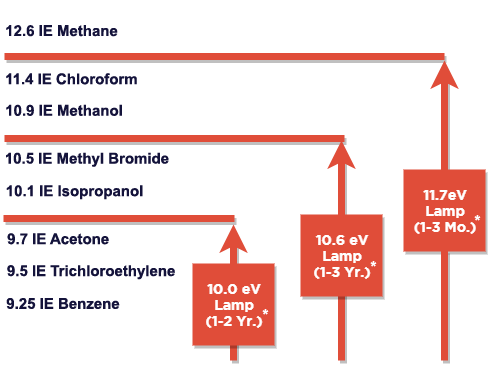
Figure 2: PID Lamp Energy Threshold
*Expected lamp life and usage
Benzene has a low IE value, as shown in Figure 2, and it is often present in a "mixture" of other chemicals, including aromatics and aliphatics. The use of a proprietary 10.0eV lamp means that only aromatics (and other gases that may be present) are detected, and benzene pre-filter tubes can be used to provide more accurate readings of benzene if total aromatic compounds (TACs) are above regulatory limits.