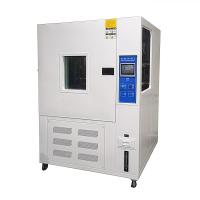
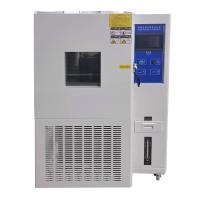
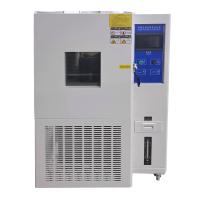
Constant temperature and humidity Test Chambers (also known as environmental Test Chambers) are designed to evaluate the quality and reliability of products under different environmental conditions, especially temperature and humidity.
Constant temperature and humidity Test Chambers are commonly used by researchers from different industries, such as electronics, electrical, communication, automotive, medical, aerospace, etc.
Let's say your company has a project that tests new products against various environmental conditions. You will be given an assignment to acquire and identify a constant temperature and Humidity Chamber capable of performing the test .
How did you get started? What criteria do you need to pay attention to when choosing a suitable constant temperature and humidity Test Chamber? Is price always your deciding factor or product quality, or after-sales service is more important to you?
In order to make a good decision about purchasing the right temperature and Humidity Chamber, several factors need to be considered. This article is written to help you make an informed decision. I'm going to share 6 things you should consider before making a choice or choice.
temperature range
humidity range
temperature change rate
Internal dimensions
test product
cooling method
temperature range
First, the temperature range is the main parameter for choosing a chamber. Manufacturers have wide temperature range chambers with different construction and insulation designs. Typically, standard temperature chambers can go as low as -70°C and as high as 150°C. "First of all, the temperature range is the main parameter for choosing a chamber" Custom chambers are available if your testing requires more than standard temperatures. Just make sure to provide your chamber supplier with the testing details. The minimum temperature required for the test determines the type of refrigeration system required. |
humidity range
Relative humidity (RH) depends on the water vapor pressure and temperature in the Test Chamber. At low temperatures, the system can achieve high relative humidity with less water vapor. On the other hand, more water vapor is required to achieve high relative humidity at higher temperatures.
The standard temperature-humidity range for most Test Chambers is 10°C to 85°C with a relative humidity of 10% to 98%. There is a limit to the minimum temperature the chamber can reach due to the possible formation of dew or fog. The dew point of a Test Chamber is usually defined as 10°C. In the Test Chamber, the refrigerated coils were never set at 10°C or below freezing, so frost did not form.
"The standard temperature-humidity range for most Test Chambers is 10°C to 85°C, with 10% to 98% RH"

figure 1
The range of RH that can be achieved at a certain temperature is shown in Figure 1. For example, the minimum humidity level for a chamber at 20°C is 40% RH. At a temperature of 60°C, the chamber can reach 20% RH. You need to operate the Test Chamber within the limits set by the manufacturer. Any attempt to set outside this range may result in damage to the refrigeration system.
temperature change rate
There are different types of profiles in terms of temperature testing. These tests can be divided into 3 groups as described below:
1. Constant temperature or temperature cycle test
For isothermal testing, it sets a specific duration at a specific temperature. However, for temperature cycling tests, the temperature can be multiple temperatures for different durations.

figure 2
Figure 2 shows a typical temperature cycling test profile. In addition, the rate of temperature change during heating is generally not greater than 3°C/min, and the rate of change during cooling is generally not greater than 1°C/min.
2. Rapid temperature change test
Similar to the temperature test cycle described above, the rapid temperature test is performed with higher temperature changes, i.e. up to 20°C per minute. This test is also commonly known as ESS (Environmental Stress Screening), HALT (Highly Accelerated Stress Test) or HASS (Highly Accelerated Stress Screening). The purpose of this test is to allow you to evaluate product quality based on rapid temperature changes.

image 3
Figure 3 shows the rapid temperature change cycle test. It is important to note that the part (specimen) temperature always lags the air temperature in the chamber.
The Test Chamber manufacturer will have to design the airflow inside the chamber so that the airflow has enough volume to move the air temperature at a rate close to the part temperature.
3. Thermal shock
In thermal shock testing, products are repeatedly subjected to extreme low and high temperature changes at extremely fast switching rates. This test stimulates accelerated stress on the product caused by thermal shock during normal use.
Temperature changes between hot and cold temperatures occur at a very rapid rate, greater than 15°C per minute.

Figure 4
Thermal shock Test Chambers are usually divided into 3 zones or 2 zone chambers.
For a 3-zone thermal shock chamber, the chamber consists of a hot temperature zone, a cold temperature zone, and a test zone. The product is placed in the test area, and hot air and cold air are blown in alternately from the corresponding chamber.
Some equipment uses 2 separate hot and cold chambers (2 zones) with a lift mechanism for the product transiting between these 2 compartments.
Internal dimensions
Chamber interior size is always overlooked by buyers. Most people mistakenly think that indoor performance does not depend on the space, as long as the product can fit in the indoor, no matter the size of the product.
It is important to know that the chamber needs to have sufficient air volume to ensure effective airflow. Therefore, it is better to get a chamber slightly larger than to buy a chamber that is too small.
"It is important to know that the chamber needs to have sufficient air volume to ensure effective airflow"
Wide range of sizes and dimensions can be customized according to your requirements. Test chamber sizes can range from small benchtop chambers with walk-in chambers.
test product
Experienced manufacturers always ask potential buyers questions: what is a sample/product and what is the quantity? The answer allows the manufacturer to provide a chamber that is fine for your application.
"What is the sample/product and what is the quantity?"
There are many possible scenarios for a test setup, and chamber manufacturers consider product characteristics and test requirements when designing chamber structures.
The key is, make sure to test all the details to your room provider.
cooling method
The air in the chamber is cooled with a refrigeration system. The heat extracted by the refrigeration system is dissipated through the condenser.
There are two main types of condensers: air-cooled or water-cooled. Each has its pros and cons.
Air-cooled standard sizes are often used for small chambers. This configuration is very convenient in terms of mobility and saving space, since the air-cooled condenser is built into the chamber.
On the other hand, however, the heat is dissipated into the room where the chamber is located. Therefore, the air conditioner in the room needs to be able to handle the additional heat load generated by the chamber.
Second, you need to pay attention to the dirt around you. Since the condenser is located near the floor, it can easily pick up dirt. Therefore, regular cleaning of the condenser is necessary.
If the chamber is located in a dirty environment, water cooling may be a good solution. In a water-cooled system, the condenser is usually placed outside.
However, water cooling systems are more complicated and expensive to install. These types of systems require refrigeration piping, water tower installation, electrical wiring and water works. As you can see, the installation can be messy and cost you extra.
"Water cooling may be a good solution if the chamber is located in a dirty environment"
Summarize
As a conclusion, there are many different types of Test Chambers in use. To determine which type of chamber you need, you need to define your application.
You need to communicate testing and product information to suppliers in as much detail as possible.
What is the required chamber size? What is a sample? What temperature or humidity range is required? Is the chamber air-cooled or water-cooled?
These are the basic questions you need to ask before purchasing a constant temperature and humidity Test Chamber.