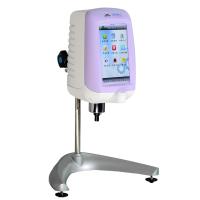
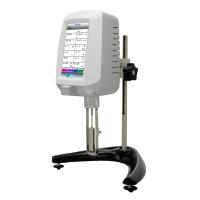
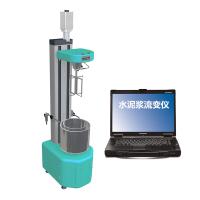
When you're looking to buy a viscometer to help you maintain the proper viscosity during printing, coating, or painting, you've likely come across another type of viscosity-measuring device called a rheometer. Rheometers are similar in principle to viscometers, but they tend to be more expensive. This is partly because they have a wider range of applications.
There are some other key differences between the two devices, but before we explain them, we need to briefly explore the field of rheology.
What is rheology?
Wikipedia gives the following definition of rheology:
Rheology is the study of the flow of substances, primarily liquids, but also as "soft solids" or solids, under conditions where they respond to plastic flow, rather than deform elastically in response to applied forces...it applies to substances that have Complex microstructures such as slurries, sludges, suspensions, polymers and other glass formers (such as silicates), as well as many foods and additives, body fluids (such as blood) and other biological materials or other soft substances belonging to a class Such as food.
Non-Newtonian fluids have more complex rheological properties than Newtonian fluids. We will discuss non-Newtonian fluids in the next blog post, but for now one thing to remember is that the viscosity of a non-Newtonian fluid changes when a force is applied.
Think about the last time you went to a restaurant and had a bottle of ketchup. If the ketchup refuses to pour, what do you do? You shake the bottle, causing the ketchup to flow more easily. It works because ketchup is a non-Newtonian fluid.
What is a rheometer?
Depending on your requirements, you may hear that rheometers are a subset of viscometers and vice versa. Technically, viscometry is a part of rheology, and rheometry is a part of rheology - meaning that viscosity falls within the larger category of rheology.
Regardless of how they are classified, the function of rheometers is to measure the rheological properties of fluids, which also yield the viscosity of non-Newtonian fluids.
To accomplish their task, many rheometers apply some type of shear force to the fluid being measured. The result of measuring this stress yields the rheological properties of the fluid, including its viscosity (which in rheology is not represented by a single value).
Should I use a viscometer or a rheometer?
Whether you need a viscometer or a rheometer to monitor viscosity in your process depends entirely on the fluid you are using. Some viscometers (such as resonance frequency viscometers) may induce some shear forces on the fluid, providing some input from the rheometer. Some manufacturers may require both, while others may need to use one - and examining each application out there is well beyond the scope of this article.