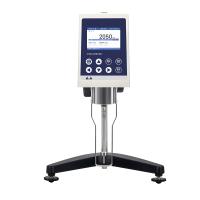
Here are the six types we'll cover:
Flow Cup Viscometer
Capillary Viscometer
Falling Stick Viscometer
Rotational Viscometer
Falling Ball Viscometer
Vibration Viscometer
#1 - Flow Cup Viscometer
A Flow Cup viscometer usually consists of a cup with a hole through which the fluid flows. Viscosity is determined by timing the time it takes the cup to empty and is measured in cup seconds. Flow cup viscometers are easy to use manually thanks to the fact that they are only immersed in the liquid being processed - making them popular in the coatings industry. They include Zahn Cups, Ford Cups and many more.
#2 - Capillary Viscometer
Capillary viscometers are also known as U-tube viscometers and include the Ostwald and Ubbelohde variants. Intuitive and easy to use, they consist of a U-shaped glass tube with two bulbs (one taller and one lower). Fluid is passed from the upper bulb to the lower bulb through capillary tubes, and viscosity is measured by calculating the time it takes the fluid to travel through the tube.
#3 - Falling Stick Viscometer
According to Wikipedia, Austin Norcross invented the drop piston viscometer, which is why they are also called Norcross viscometers. They function by drawing the fluid being measured into the piston cylinder as the piston rises; the time it takes the piston to fall (fall time seconds) due to the fluid's resistance is used to determine viscosity. The drop piston viscometer is easy to use and easy to maintain, and has a long service life.
#4 - Rotational Viscometer
A Rotational Viscometer measures viscosity by immersing a rotating shaft in the fluid being measured. The power (torque) required to turn the spindle indicates the viscosity of the fluid, and since Rotational Viscometers do not use gravity to function, their measurements are based on the internal shear stress of the fluid.
#5 - Falling Ball Viscometer
Falling ball viscometers work similarly to piston viscometers. With this type of viscometer, a ball is dropped into a sample of the fluid being measured. The size of the ball is known, so the viscosity is determined by calculating how long it takes the ball (again using fall time seconds) to fall the fluid through gravity.
#6 - Vibrating Viscometer
Vibratory viscometers measure viscosity using a powered vibrating rod. Different fluids are more or less resistant to vibration, depending on how viscous they are. Thus, by measuring the decay of the vibration, or by measuring the rate at which the vibration of the viscometer decreases, the viscosity can be determined. Vibrating viscometers are very popular because of their high sensitivity and no moving parts.