overview
Viscosity is a major parameter when making any flow measurement on fluids such as liquids, semi-solids, gases or even solids. The Bubler fly handles liquids and semi-solids. Viscosity measurement is performed in conjunction with product quality and efficiency. Anyone involved in flow characterization, research or development, quality control, or fluid transfer will be involved in some type of viscosity measurement.
Many manufacturers now consider viscometers an essential part of their research, development and process control programs. They know that viscosity measurement is often the fastest, accurate and most reliable method of analyzing some of the important factors that affect product performance.
Rheo-relationships help us understand the fluids we're working with so we can know how they behave, or force them to behave as we want.
There are many different viscosity measurement techniques, each suited to specific circumstances and materials. Selecting the correct viscometer from the wide variety of instruments available to meet the needs of any application can be a difficult proposition. Today's instruments vary from the simple to the complex: from counting the seconds of liquids, to expulsion rods, to very sophisticated automatic recording and control devices. This puts the instrument user in a position where his own appreciation of the flow phenomena involved, together with the "knowledge and experience" of the instrument manufacturer, need to be assumed.
Brookfield was a pioneer in the development of instruments for viscosity measurement and data processing and was a stimulus for scientific development. We have the necessary "knowledge and experience" to be your partner in selecting the right instrument to control your process.
Why Rheological Measurements?
Anyone beginning to learn the logic of rheology needs to start by asking the question, "Why am I making viscosity measurements?" The answer depends on the experience of thousands of people making such measurements, showing that many useful behaviors can be obtained for a variety of products and predictive information, as well as knowledge of the effects of handling, formulation changes, aging phenomena, etc.
A common reason for measuring rheological properties can be found in the field of quality control, where raw materials need to be consistent from batch to batch. For this reason, flow behavior is an indirect measure of product consistency and quality.
Another reason for conducting flow behavior studies is to obtain a direct assessment of processability. For example, high viscosity liquids require more pumping power than low viscosity liquids. Therefore, understanding its rheological behavior is useful when designing pumping and piping systems.
It has been suggested that rheology is the most sensitive material characterization method because flow behavior responds to properties such as molecular weight and molecular weight distribution. This relationship is useful in polymer synthesis, for example, because it allows relative differences to be seen without molecular weight measurements. Rheological measurements can also be used to follow the course of chemical reactions. This measurement can be used during production as a quality check or to monitor and/or control the process. Rheological measurements allow to study the course of chemical, mechanical and thermal treatments, the influence of additives or curing reactions. They are also a means of predicting and controlling a wide range of product properties, end-use performance and material behavior.
To start thinking logically, consider the question, "Can certain rheological parameters be used to correlate to certain aspects of a product or process?" To determine this, it is necessary to address the various chemical and Physical phenomena develop an instinct. For now, it is assumed that this information is known, and several possibilities have been identified. The next step is to collect preliminary rheological data to determine what type of flow behavior characterizes the system under consideration. At the most basic level, this involves taking measurements with any Brookfield viscometer and drawing some conclusions based on the ensuing description of flow behavior.
Once the type of flow behavior is identified, you can learn more about how system components interact. The data thus obtained can then be fitted to one of the mathematical models that have been successfully used with Brookfield instruments.
Such mathematical models range from very simple to very complex. Some of them simply involve plotting data on graph paper; others require calculating the ratio of two numbers. Some are very complex and require the use of a programmable calculator or computer. This kind of analysis is a great way to get the most out of our data, and usually results in one of two constants that aggregate the data and can be related to product or process performance.
Once a correlation has been established between rheological data and product behavior, the process can be reversed and rheological data can be used to predict performance and behavior. Rheology vs. Rheology Rheology is defined by Webster's dictionary as "the study of changes in form and flow of matter, including elasticity, viscosity, and plasticity.
In this chapter we focus on viscosity, further defined as the internal friction of a fluid caused by molecular attraction, making it resist the tendency to flow. Your Bübler fly viscometer measures this friction and thus serves as a tool for rheology. The purpose of this chapter is to give you an understanding of the different types of flow behavior and the use of the Brookfield Viscometer as a rheological instrument, enabling you to perform detailed analysis of almost any fluid. This information is useful to all viscometer users, especially those adhering to theoretical and academic viscometry ideas.
viscosity
Viscosity is a measure of the internal friction of a fluid. This friction becomes apparent when moving one layer of fluid relative to another. The greater the friction, the greater the force required to cause this movement, known as shear. Shear occurs whenever a fluid is physically moved or distributed, such as pouring, spreading, spraying, mixing, etc. Therefore, high viscosity fluids require more force to move than non-viscous materials.
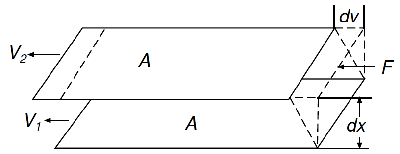
Isaac Newton defined viscosity by considering the model shown in the figure above. Two parallel fluid planes of equal area A are separated by a distance dx and are moving in the same direction with different velocities V1 and V2. Newton postulated that the force required to maintain this velocity difference is proportional to the velocity difference, or velocity gradient, through the liquid. To express this, Newton wrote:

The velocity gradient dv/dx is a measure of the change in velocity of the intermediate layers moving relative to each other. It describes the experience of shearing a liquid, hence the name shear rate. In the discussion that follows, this will be denoted S. Its unit of measurement is called reciprocal seconds (sec-1).
The term F/A means the force per unit required to produce a shearing action. It is called shear stress and will be denoted by F'. It is measured in dynes per square centimeter (dynes/cm2).
Using these simplified terms, viscosity can be defined mathematically by the following formula:
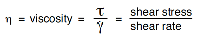
The basic unit of viscosity measurement is equilibrium. A material that requires a shear stress of one dyne per square centimeter to produce a shear rate of one reciprocal second has a viscosity of one poise, or 100 centipoise. You will come across viscosity measurements expressed in Pascal-seconds (Pa s) or MilliPascal-seconds (mPa s); these are units of the International System that are sometimes used in preference to metric standards. One pascal-second is equal to ten flat; one millipascal-second is equal to one centipoise.
Newton assumed that all materials have a viscosity independent of shear rate at a given temperature. In other words, twice the force moves the fluid twice. As we shall see, Newton was only partly right.
Newtonian fluids
This type of flow behavior was postulated by Newton for all liquids known, not surprisingly, for Newton. However, it is only one of several flow behaviors you may experience. A Newtonian fluid is represented graphically in the figure below. Panel A shows that the relationship between shear stress (F') and shear rate (S) is a straight line. Curve B shows that the viscosity of the fluid remains constant as the shear rate is varied. Typical Newtonian fluids include water and thin motor oil.
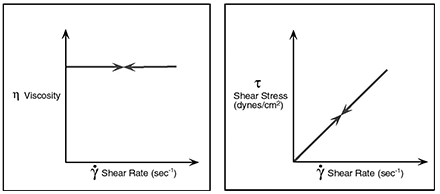
What this means in practice is that, at a given temperature, the viscosity of a Newtonian fluid will remain the same no matter which viscometer model, spindle or velocity you use to measure it. Brookfield Viscosity Standards are Newtonian in the range of shear rates produced by Brookfield equipment; that is why they are suitable for all our viscometer models. Newtonian is by far the easiest fluid to measure - just grab your viscometer and go. Unfortunately, they are not as common as the more complex group of fluids, non-Newtonian fluids, discussed in the next section.
非牛顿流体非牛顿流体广义地定义为关系F'/ S不是常数的流体。换句话说,当剪切速率变化时,剪切应力不会以相同的比例(或甚至需要在相同的方向上)变化。因此,这种流体的粘度随着剪切速率的变化而变化。因此,粘度计模型,主轴和速度的实验参数都对非牛顿流体的测量粘度有影响。该测量的粘度称为流体的表观粘度,并且仅在提供并遵守明确的实验参数时才是准确的。
通过将任何流体视为具有不同形状和尺寸的分子的混合物,可以设想非牛顿流动。当它们在流动过程中相互通过时,它们的大小,形状和内聚性将决定移动它们需要多大的力。在每个特定的剪切速率下,对准可以是不同的,并且可能需要或多或少的力来保持运动。
存在几种类型的非牛顿流动行为,其特征在于流体的粘度随剪切速率的变化而变化的方式。您可能遇到的常见类型的非牛顿流体包括:
假性肿瘤
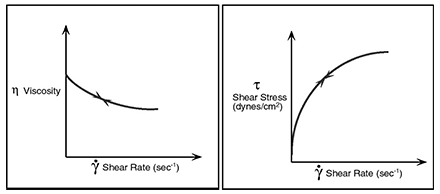
这种类型的流体将随着剪切速率的增加而显示出粘度降低,如下图所示。可能是常见的非牛顿流体,假塑料包括油漆,乳液和许多类型的分散体。这种类型的流动行为有时被称为剪切稀化。
胀流
与增加的剪切速率增加粘度表征胀流型流体; 见下图。尽管比假塑性更少量,但在含有高水平的抗絮凝固体的流体中经常观察到膨胀,例如粘土浆料,糖果化合物,水中的玉米淀粉和砂/水混合物。膨胀也称为剪切增稠流动行为。
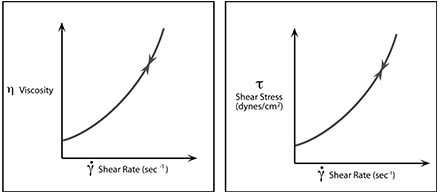
塑料
这种类型的流体在静态条件下表现为固体。在引起任何流动之前需要对流体施加一定量的力; 这种力称为屈服值。番茄酱是这种液体的一个很好的例子; 它的屈服值通常会使它拒绝从瓶中倒出,直到摇动或敲击瓶子,使猫酱可以自由地喷出。一旦超过屈服值并开始流动,塑性流体可显示出牛顿流,假塑性或膨胀流动特征。见下图。
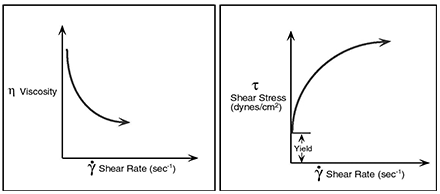
到目前为止,我们只讨论了剪切速率对非牛顿流体的影响。当考虑时间因素时会发生什么?这个问题引导我们检验另外两种类型的非牛顿流:触变性和流变性。
触变性和流变性
有些流体在恒定剪切速率条件下会随时间发生粘度变化。有两类需要考虑:
触变性
如下图所示,触变性流体的粘度会随着时间的推移而降低,同时会受到持续的剪切。
Rheopexy
这与触变行为基本相反,因为流体的粘度随着时间的推移而增加,因为它以恒定的速率剪切。见下图。
触变性和流变性可以与任何前面讨论的流动行为组合或仅在某些剪切速率下发生。时间元素变化很大; 在恒定剪切条件下,一些流体将在几秒钟内达到其最终粘度值,而其他流体可能需要长达数天。
很少遇到流变流体。然而,在诸如油脂,重印刷油墨和涂料的材料中经常观察到触变性。
当受到不同的剪切速率时,触变性流体将如下图所示发生反应。剪切应力与剪切速率的关系曲线随剪切速率增加到一定值,然后立即降低到起始点。请注意,向上和向下曲线不重合。这种磁滞回线是由于流体粘度随着剪切时间的增加而降低而引起的。这种影响可能是也可能不是可逆的; 一些触变性流体,如果允许静置一段时间,将恢复其初始粘度,而其他人永远不会。
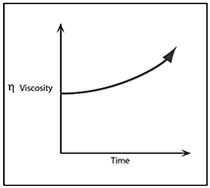
当然,流体的流变行为对粘度测量技术具有深远的影响。稍后我们将讨论其中一些影响以及处理它们的方法。
层流和湍流粘度的定义意味着存在所谓的层流:一层流体经过另一层而没有物质从一层物质转移到另一层物质。粘度是这些层之间的摩擦力。
取决于许多因素,存在一层流体相对于另一层流动的某个最大速度,超过该最大速度会发生实际的质量传递。这称为湍流。分子或较大的颗粒从一层跳到另一层,并在该过程中消耗大量的能量。最终结果是,与相同速度的层流相比,需要更大的能量输入来维持这种湍流。
增加的能量输入表现为明显比在相同剪切速率下在层流条件下观察到的剪切应力更大。这导致错误的高粘度读数。
层流流入湍流的点除了层移动的速度之外还取决于其他因素。材料的粘度和比重以及粘度计主轴和样品容器的几何形状都会影响这种转变发生的点。
应注意区分湍流条件和膨胀流动行为。通常,膨胀材料随着剪切速率的增加会显示出稳定增加的粘度; 湍流的特征在于在一定剪切速率以上粘度的相对突然和显着的增加。在此点之下,材料的流动行为可能是牛顿流动或非牛顿流动。
由于大多数布博勒飞粘度计的剪切速率相对较低,除非使用LV系列粘度计测量低于15 cP的粘度或使用其他型号测量85 cP,否则不太可能遇到湍流。流体的粘度越高,经历湍流的可能性就越小。如果在测量低粘度流体时观察到湍流,通常可以使用UL Adapter™附件消除湍流。
什么影响了流变性?
粘度数据通常用作“窗口”,通过该窗口可以观察到材料的其他特征。粘度比影响粘度的某些特性更容易测量,使其成为材料表征的有用工具。在本章的前面部分,我们讨论了各种类型的流变行为以及如何识别它们。确定了材料中的特定流变行为后,您可能想知道这些信息对其他特征的暗示。本节基于多年客户体验收集的信息,旨在让您思考粘度计可以帮助您解决的谜团。
温度
可能对材料的流变行为产生影响的最明显因素之一是温度。一些材料对温度非常敏感,相对小的变化将导致粘度的显着变化。其他人则相对麻木不仁。考虑温度对粘度的影响对于评估在使用或加工中会经受温度变化的材料(例如机油,润滑脂和热熔粘合剂)是所需的。
剪切率
In the real world, non-Newtonian fluids tend to be the rule rather than the exception, so the effect of shear rate is necessary for anyone engaging in practical applications of rheological data. For example, trying to pump inflation fluid through the system, only to have it solidify inside the pump, bringing the whole process to a sudden stop, would be disastrous. Although this is an extreme example, the importance of the shear rate effect should not be underestimated.
When a material is subjected to various shear rates during processing or use, it is necessary to know its viscosity at a predetermined shear rate. If these are not known, an estimate should be made. Viscosity measurements should then be made at a shear rate as close as possible to the estimated value.
Since these values fall outside the shear rate range of the viscometer, it is usually not possible to approach the expected shear rate values during the measurement. In such cases, it is necessary to perform measurements at several shear rates and extrapolate the data to expected values. This is not an accurate way to obtain this information, but it is often a useful alternative, especially when the predicted shear rates are very high. In fact, it is always recommended to perform viscosity measurements at several shear rates in order to detect rheological behavior that may have an impact on processing or use. In cases where the shear rate value is unknown or not important, a sample plot of viscosity versus RPM is usually sufficient.
Examples of materials that are subject to and are affected by wide variations in shear rates during processing and use are: paints, cosmetics, liquid latex, paints, certain foods and blood in the human circulatory system. The table below shows typical examples of different shear rates.
