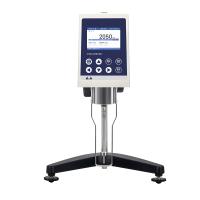
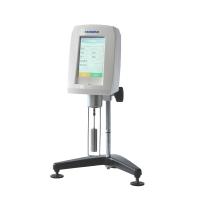
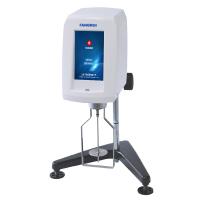
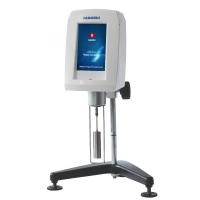
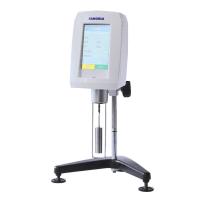
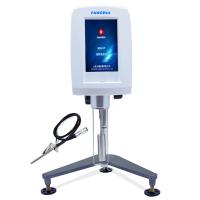
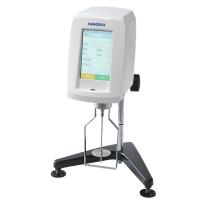
Liquids are divided into Newtonian liquids and non-Newtonian liquids. The viscosity of a Newtonian liquid is only related to temperature and decreases with increasing temperature. The viscosity of a non-Newtonian liquid is not only related to temperature, but also related to shear rate and time, and has a change of shear thinning or shear thickening. Pure liquids and solutions of low molecular substances are Newtonian liquids; most liquids, such as polymer solutions, colloidal solutions, emulsions, suspensions, ointments, and solid-liquid inhomogeneous systems, are non-Newtonian liquids. Ordinary digital viscometers without data processing function measure the viscosity value at a certain point (at a certain temperature and time shear rate). If the tested sample is a Newtonian liquid, then the viscosity value at a constant temperature is constant, and the value at a certain point represents the viscosity of the liquid. However, if the measurement is a non-Newtonian liquid whose viscosity varies with the speed, rotor, and time, it is much more difficult to obtain an accurate value. Ordinary viscometers can measure Newtonian liquids, but are powerless for non-Newtonian liquids. Because the viscosity data of ordinary viscometers changes from time to time when testing non-Newtonian liquids, it is difficult to obtain an accurate value.
The viscometers that are most suitable for the pharmaceutical industry are Rotational Viscometers, Pinnacle kinematic viscometers and Ubbelohde viscometers. Comprehensive comparison shows that the accuracy of kinematic viscometers for detecting viscosity, while Rotational Viscometers are relatively simple compared to kinematic viscometers. Digital type The Rotational Viscometer is more convenient to use and read the results.
An important application of Rotational Viscometers in the pharmaceutical industry is to measure the viscosity of pharmaceutical thickeners. Pharmaceutical thickener is a kind of pharmaceutical excipients, used to increase the viscosity of liquid or paste, such as used in eye drops to adjust the viscosity of the liquid can make eye drops stay in the eye for a long time, use In the ointment can make the ointment easy to apply.
In the Chinese Pharmacopoeia, the viscosity of the following excipients is tested with a Rotational Viscometer: carbomer, methylcellulose, hypromellose, polyvinyl alcohol and polymethacrylic resin. However, the description of the test method is not very sufficient. In contrast, the viscosity test method in the United States Pharmacopoeia is very detailed, from the processing of the sample to the type and size of the rotor of the viscometer for testing, etc., because during the viscosity test process, in addition to being affected by the external environment (temperature, In addition to the influence of pressure and sample state), the measuring instrument, viscometer, has a great influence on the accuracy of measurement.
In addition to the application of Rotational Viscometers for pharmaceutical excipients, it is also necessary to test the viscosity in the sol process of the capsule production process. The main components of capsules are gelatin, glycerin and other medicinal materials. Analyze the physical and chemical properties of gelatin as a raw material, and adjust the ratio of sol formula according to local conditions, so as to obtain a gel solution that meets the production requirements and has a relatively constant quality as much as possible. The quality of the sol process has half or more determined the completion of the batch of glue production (production speed efficiency, whether the machine head is smooth or not, the reject rate, etc.). The main indicators of a batch of gelatin raw materials are: viscosity, freezing ability, water content, transparency, etc. In order to control the quality, viscosity testing is necessary, including controlling the quality of the raw material gelatin and the quality of the glue in the production process.
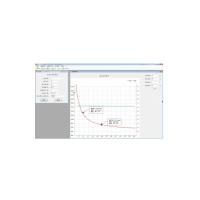
In addition to being used in quality inspection, Rotational Viscometers are also widely used in the research and development of pharmaceuticals, especially in the formulation design of some ointments and injections. Different formulations lead to different rheological properties of pharmaceuticals, which has a great impact on the production and use of pharmaceuticals. big impact. Use Rotational Viscometer/rheometer to carry out pharmaceutical formula design and rheological research. The new viscometer/rheometer can also be controlled by computer, and different data can be obtained according to different test conditions, which can be more comprehensive. Responding to the rheological behavior of pharmaceuticals is of great value in the development and quality testing of some pharmaceuticals!