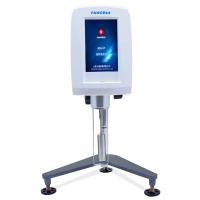
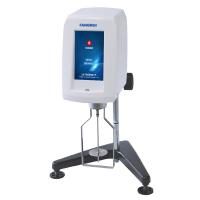
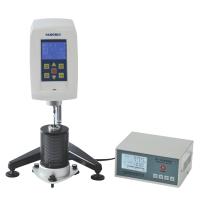
In actual engineering and industrial production, it is often necessary to detect the viscosity of the fluid online to ensure the best process operating environment and product quality, thereby improving production efficiency. Through the online measurement of the liquid viscosity in the process, the data of the rheological behavior of the liquid can be obtained, which has important guiding value for predicting the process control of the product process, the conveyability and the operability of the product during use. The properties of the liquid are often related to other properties of the product such as color, density, stability, changes in solid content and molecular weight, and a convenient and sensitive method to detect these properties is to detect the viscosity of the liquid online. In the production process, online viscosity detection is carried out according to the range of process technical requirements, which can minimize the scrap rate of products and the downtime of production lines.
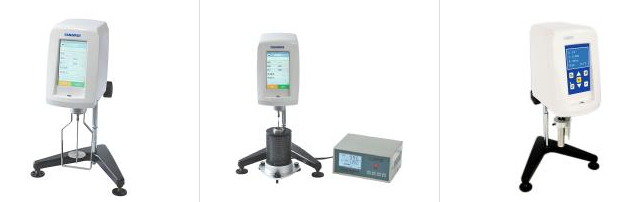
Viscometers are as good to operate and value as laboratory instruments. In addition, we pay special attention to the durability of the instrument, as well as the long-term and convenient maintenance required by the industrial environment, which make the online detection viscometer the key choice for online measurement in various industries. The core component of the on-line detection viscometer is the vibrating rod driven by a conventional power supply. Depending on the viscosity of the fluid the vibrator is in contact with, the vibration amplitude will vary.
Types of viscometers
1. Viscometer: Brookfield viscometer and NDJ series in domestic standards. There is also a Brabender viscometer commonly used to continuously track viscosity changes during starch gelatinization, which is said to be the same principle;
2. Capillary type: various forms such as Ubbelohde, Pinnock, Finn, and countercurrent;
3. Cup type: Engler viscometer, Ford cup in the United States, Zahn cup in Japan and Tu-4 cup in my country;
4. Falling ball type;
5. Others: One can measure the viscosity of glass or ceramic droplets melted in a heating furnace. It can measure viscosity, surface tension and contact angle. The temperature range is from room temperature to 1000°C or 2100°C.
4 parameters for choosing a viscometer
1. Temperature, whether temperature control is required, and what is the temperature range;
2. The viscosity range, that is, the possible viscosity range of your sample;
3. Whether it needs to be measured at a fixed shear rate, or fixed speed, rotor, etc.;
4. The amount of sample is whether the sample is valuable or not, and whether it is necessary to control the amount of the sample.