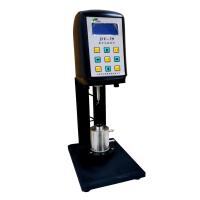
A viscometer measures the viscosity - thickness or stickiness - of a liquid created by internal friction. Viscometers typically measure the resistance of moving liquids across surfaces, a property indicative of many industrially relevant properties, such as the lubricating ability of oils, protein concentration in biomanufacturing processes, or the wetting properties of liquids.
Many types of viscometers are used in research and development settings. Common varieties are orifice, falling/moving piston, rotary, falling ball, vibratory, and capillary, which operate by measuring vibration, fluid pressure, and Coriolis force.
Capillary viscometers use a U-shaped glass tube with bulbs at each end, one taller than the other. Viscosity determination of a fluid is related to the time required for a defined quantity of fluid to travel a specified distance through a tube (of a specified diameter).
Capillary viscometers work only with Newtonian fluids - fluids with desirable flow properties; viscosity, a definable characteristic of liquids, is a subset of the broader science of rheology, which is a measure of how a material flows. Thus, the term viscosity is usually applied to pure liquids (e.g., ethanol, water), while rheology is characteristic of complex mixtures (yoghurt, paint).
For Newtonian fluids, the relationship between stress and shear rate is constant, or at least consistent, which has a direct impact on the real-world reproducibility of viscosity measurements.
Lubricants are an important segment of the viscometry market. The proper functioning of machines and large equipment depends on lubricants, but the composition of lubricants changes during normal operation.
"Soot, carbon, glycol, particulates, refrigerant gases, water, and other contaminants that enter lubricating oil during service can reduce the end user's ability to obtain consistent or repeatable viscosity measurements," said Spectro Scientific (Chew, Mass. Msford) Technical Support Director Dan Walsh. ). In other words, an off-the-shelf lubricant with a Newtonian viscosity may not exhibit this property after a week or a month of use. "Users need to pay attention to this when purchasing a viscometer."
Modern lubricants coming out of the bottle may not exhibit Newtonian behavior by themselves either. "The base stock ingredient, a petroleum product, exhibits a desirable viscosity, but manufacturers add ingredients to enhance or suppress certain properties of the main ingredient," Walsh added, "and these can lead to non-Newtonian behavior."
key cleaning
Unlike most analytical modes, where the sample is isolated from the interior of the instrument, with a capillary viscometer, the sample chamber is the instrument. Therefore, the importance of cleaning to obtain repeatable and accurate results cannot be overemphasized. Joseph T. Mastropierro, associate director of laboratory technology at Cannon Instrument Company (Pennsylvania State University), emphasizes the need for effective, meticulous cleaning. “It cannot be overemphasized how important it is to expel as much test material as possible from the viscometer prior to cleaning to speed up the cleaning process,” he said. "This can be tricky when the test material is highly viscous because it takes time to drain." Raising the temperature reduces the test material's viscosity and helps it drain more efficiently.
"The second critical step is choosing a clean solvent that will dissolve the material being tested. After adding the solvent to the viscometer, allow sufficient soak time to ensure complete dissolution and removal of the test material. A second, volatile, low viscosity solvent can Helps ensure cleanliness. Allowing for proper air drying time after solvent rinsing helps ensure complete removal of residual solvent.”
Inadequate cleaning can seriously affect the quality of subsequent viscosity tests. "Falsely higher or lower results may occur, depending on differences in the viscosity of the previously tested sample versus the current one, or the cleaning solvent used," Mastropierro added.
Capillary viscometers are reliable and time-tested, but users should choose this instrument type after considering their test fluids and the conditions under which their viscosity will be measured. "Don't just think about analysis," Walsh warns, "think about sample preparation and any interference that may exist or develop over time."