According to the Society of Tribologists and Lubrication Engineers (STLE), viscosity is one of the most important physical properties of oil. It is usually one of the first parameters measured by most oil analysis laboratories because it is important to the condition of the oil and its lubrication. But what do we really mean when we talk about the viscosity of an oil?
The viscosity of a lubricating oil is usually measured and defined in two ways, based on its kinematic viscosity or its absolute (dynamic) viscosity. While the descriptions may seem similar, there are important differences between the two.
The kinematic viscosity of an oil is defined by its resistance to flow and shear due to gravity. Imagine filling a beaker with turbine oil and another beaker with thick gear oil. Which one would flow faster from the beaker if it was sloped on its side? Turbine oil will flow faster because the relative flow rate is controlled by the kinematic viscosity of the oil.
Let us now consider absolute viscosity. To measure absolute viscosity, insert a metal rod into the same two beakers. Stir the oils with a stick, then measure the force required to stir each oil at the same rate. The force required to agitate gear oil will be greater than the force required to agitate turbine oil.
Based on this observation, it might be easy to say that gear oil requires more force to agitate because it has a higher viscosity than turbine oil. However, in this example, the oil is the resistance to flow and shear due to internal friction, so it is more accurate to say that the gear oil has a higher absolute viscosity than the turbine oil because more force is required to agitate the gear oil.
For Newtonian fluids, the absolute and kinematic viscosities are related to the specific gravity of the oil. However, for other oils, such as those containing polymeric viscosity index (VI) improvers, or heavily contaminated or degraded fluids, this relationship does not hold and can lead to errors if we do not understand the difference between absolute and kinematic viscosity .
For a more detailed discussion of absolute and kinematic viscosity, see Drew Troyer's article "Understanding Absolute and Kinematic Viscosity".
capillary viscometer test method
A common method of determining kinematic viscosity in the laboratory is by using a capillary viscometer (Figure 1). In this method, an oil sample is placed in a glass capillary U-tube and a suction is used to draw the sample through the tube until it reaches the starting position indicated on the side of the tube.
The suction is then released, allowing the sample to flow back into the tube under gravity. The narrow capillary portion of the tube controls the flow rate of the oil; more viscous grades of oil take longer to flow than thinner grades. The procedure is described in ASTM D445 and ISO 3104.
This test actually measures the kinematic viscosity of the oil since the flow rate is controlled by the oil's resistance to gravity flowing through the capillary. Viscosity is usually reported in centimeters (cSt), which is equivalent to mm2/s expressed in SI units, and is calculated from the time it takes for the oil to flow from the start point to the stop point using the calibration constants provided for each tube.
In most commercial oil analysis laboratories, the capillary viscometer method described in ASTM D445 (ISO 3104) is modified and automated using a number of commercially available automated viscometers. When used properly, these viscometers are capable of reproducing similar accuracies produced by the capillary manual viscometer method.
It is meaningless to state the viscosity of an oil unless the temperature at which the viscosity was measured is determined. Typically, viscosity is reported at one of two temperatures, 40°C (100°F) or 100°C (212°F). For most industrial oils, the kinematic viscosity at 40°C is usually measured, as this is the basis of the ISO viscosity classification system (ISO 3448).
Likewise, most engine oils are typically measured at 100°C because the SAE Engine Oil Classification System (SAE J300) refers to kinematic viscosity at 100°C (Table 1). In addition, 100°C reduces measurement disturbances from engine oil soot contamination.

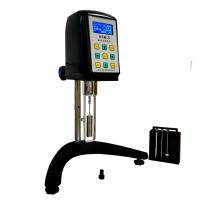
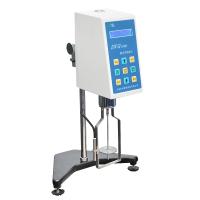
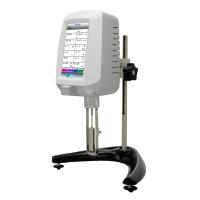
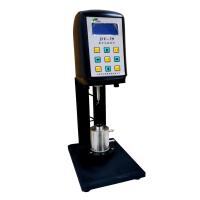
Rotational Viscometer Test Method
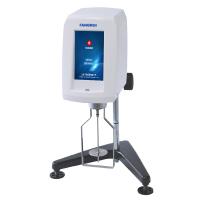
A less common method of measuring oil viscosity using a Rotational Viscometer. In this test method, the oil is placed in a glass tube contained in an insulating block at a fixed temperature (Figure 2).
The metal spindle is then rotated in the oil at a fixed speed, and the torque required to rotate the spindle is measured. Based on the internal rotational resistance provided by the oil's shear stress, the absolute viscosity of the oil can be determined. Absolute viscosity is reported in centipoise (cP), equivalent to mPa s in SI units.
This method is commonly referred to as the Brookfield method and is described in ASTM D2983.
Although less common than kinematic viscosity, absolute viscosity and Brookfield viscometers are used to formulate engine oils. For example, the "W" designation for oils suitable for use in cooler temperatures is based in part on Brookfield viscosities at different temperatures (Table 2).
Therefore, according to SAE J300, a multigrade engine oil designated as SAE 15W-40 needs to meet the kinematic viscosity limits at high temperature in Table 1, and the minimum requirements for cold start shown in Table 2.
viscosity index
Another important property of oil is the viscosity index (VI). The viscosity index is a unitless number used to express the temperature dependence of the kinematic viscosity of an oil.
It is based on comparing the kinematic viscosity of the test oil at 40°C with the kinematic viscosity of two reference oils - one with a VI of 0 and the other with a VI of 100 (Figure 3) - each at 100°C as The viscosity of the test oils is the same. Tables for calculating VI from measured kinematic viscosities of oils at 40°C and 100°C are referenced in ASTM D2270.

Figure 3 shows that an oil with a smaller change in kinematic viscosity with temperature will have a higher VI than an oil with a greater change in viscosity over the same temperature range.
For most paraffinic, solvent-refined mineral-based industrial oils, the typical VI is in the range of 90 to 105. However, many highly refined mineral oils, synthetics and VI modified oils have VIs in excess of 100. In fact, PAO type synthetic oils typically have a VI of 130 to 150.
Viscosity Monitoring and Trending
Monitoring and trending viscosity can be one of the important components of any petroleum analysis program. Even small changes in viscosity can be magnified at operating temperatures to the point where the oil can no longer provide adequate lubrication.
Typical industrial oil limits are set at ±5% for caution and ±10% for critical equipment, although severe applications and extremely critical systems should have more stringent targets.
A significant reduction in viscosity can result in:
Oil film loss causing excessive wear
Increased mechanical friction leads to excessive energy consumption n heat generated due to mechanical friction n internal or external leakage
Increased susceptibility to particle contamination due to reduced oil film
Oil film failure at high temperatures, high loads or during start-up or coasting.
Likewise, too high a viscosity can cause:
Excessive heat generation leads to oil oxidation, sludge and varnish build-up
Gas cavitation due to insufficient oil flow to pumps and bearings
Insufficient lubrication due to insufficient oil flow
oil whip in journal
Excess energy expended to overcome fluid friction
Bad or destructive air
Poor cold start pumpability.
Whenever a significant change in viscosity is observed, the root cause of the problem should always be investigated and corrected. Changes in viscosity may be the result of changes in base oil chemistry (changes in oil molecular structure) or ingress of contaminants (Table 3).

Viscosity changes may require additional testing such as: Acid Number (AN) or Fourier Transform Infrared Spectroscopy (FTIR) to confirm incipient oxidation; Contaminant testing to identify signs of water, soot or glycol ingress; or others Less commonly used tests, such as ultracentrifugation tests or gas chromatography (GC), to determine changes in base oil chemistry.
Viscosity is an important physical property that needs to be carefully monitored and controlled as it affects the oil and its effect on equipment life.
Whether measuring viscosity in situ with one of the field oil analysis instruments that can accurately determine changes in viscosity, or sending samples to an outside laboratory on a regular basis, it is important to understand how viscosity is determined and how changes can affect equipment reliability. A proactive approach is needed to identify the lifeblood of your equipment - oil!