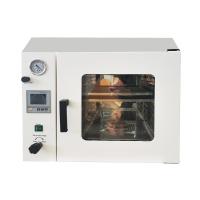
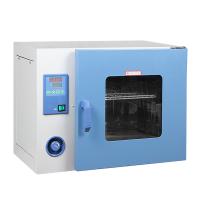
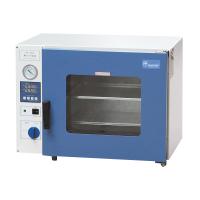
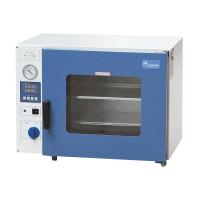
Usually, a vacuum oven only evaluates its temperature stability, not its temperature deviation. This is because the gauge reading in the vacuum oven is very different from the thermometer reading in the vacuum chamber. The electric heating vacuum Drying Oven adopts the method of heating the wall of the vacuum chamber first, and then radiating from the wall to heat the workpiece.
In this way, the temperature sensor of the temperature control instrument can be arranged on the outer wall of the vacuum chamber. The sensor can accept convective, conductive and radiant heat simultaneously. The thermometer in the vacuum chamber can only accept radiant heat, and its blackness cannot reach 1, and a considerable part of the radiant heat is refracted. Therefore, the temperature value reflected by the thermometer must be lower than the temperature reading of the instrument. Generally speaking, it is normal that the difference between the temperature reading of the instrument and the reading of the thermometer is within 30 °C under the working condition of 200 °C, so the vacuum box does not examine the temperature deviation but only the temperature stability. According to JB/T9505-1999, this indicator is the value of the temperature measured continuously for 24 hours without changing the test temperature of the vacuum box. The test standard can be a standard mercury thermometer or a thermocouple. These two standard instruments have their own characteristics. The standard mercury thermometer is placed in the center of the box during the test, where it can be read from the glass window. It is read every 2 hours during the measurement. The operation is more convenient, but it cannot automatically record the data. The thermocouple needs to be stripped into a bare wire, and connected to the digital Recorder outside through the sealing strip of the door from the center of the box. NBCHAO reminds you: the vacuum degree of the box cannot be affected when you take it out. The advantage of this measurement method is that it can automatically detect and record data, and it is not necessary to read it every 2 hours. Metering technical institutions select detection methods according to different situations. When the accuracy of the standard device meets the requirements, these two methods are optional. Test once every 2 hours, 12 times in total, read 6 temperature values at equal intervals within 5 minutes each time, and calculate the average temperature. Compare the difference between the 12 average temperatures and the reference temperature, and take the maximum difference as the temperature stability, which should be ≤2°C.