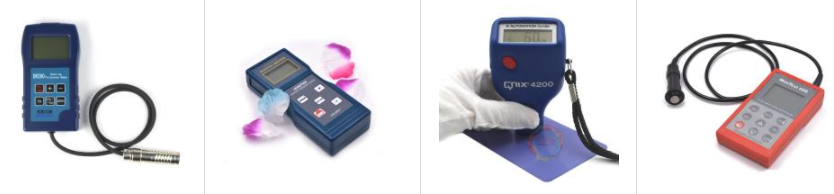
The importance of determining the dry film thickness is to ensure that the coating reaches the specified thickness and avoid premature failure of the coating due to improper thickness. The measurement of dry film thickness needs to be measured with a dry Film Thickness Gauge after the coating film is completely dry. The commonly used dry Film Thickness Gauges are: magnetic Thickness Gauge, fixed probe Thickness Gauge, eddy current gauge and destructive Thickness Gauge. Magnetic Thickness Gauges are widely used at present. Among them, there is a pen-type Thickness Gauge, which is very convenient for on-site inspection and not for precision inspection. When measuring, the magnetic probe at the tip of the pen needs to be in contact with and perpendicular to the coating surface. When the tension of the spring exceeds the gravitational force of the probe on the iron substrate, the magnetic probe at the tip of the pen is disconnected from the coating surface, and the reading at the moment of separation is dry film thickness.
When testing, the selection of measurement points should pay attention to the uniformity and representativeness of the distribution. For a large-area flat surface, measure one point every 2m2, measure each point three times, and calculate the arithmetic mean value. Welds, rivets and other parts that are really difficult to measure may not be measured, but in order to prevent the coating from being too thin, it should be painted by hand. For small areas or components, it is necessary to ensure that each side should have more than three detection points. The requirements for dry film thickness are generally as follows: the average value of all thickness measurement points should not be lower than 90% of the specified dry film thickness; the number of measurement points that do not reach the specified dry film thickness should not exceed 10% of the total number of measurement points. Those who do not reach the specified thickness should be treated as follows: if the pass rate is less than 80%, it needs to be repainted comprehensively; if the pass rate is 80%~90%, it should be partially painted according to the situation; welds and rivets need to be repainted It is generally not a problem if the film thickness of many coatings exceeds the specified standard in one coating, but it brings excessive loss of coatings and an increase in coating expenses. However, high film thickness cannot produce defects such as excessive sagging, wrinkling or cracking. Since the coating is too thick, it will affect the volatilization and complete drying of the solvent, as well as the curing of the next coating, so attention should be paid. When the film thickness exceeds 10% of the specified maximum dry film thickness, try to solve it.