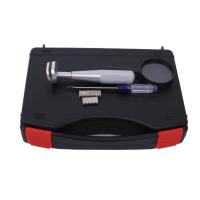
Operation and usage
1. The test piece needs to be prepared according to the provisions of ISO 1514 and ISO 2808.
2. Place the test piece on a flat plate with sufficient hardness.
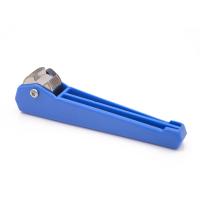
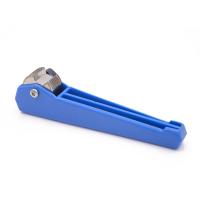
3. Holding the handle of the cross-cutting device, make the multi-edged cutting knife perpendicular to the plane of the test plate.
4. Use uniform pressure, steady and non-vibrating method to cut at a cutting speed of 20~50mm/s.
5. Rotate the test piece by 90°, and repeat the above operation on the incision made to form a lattice pattern.
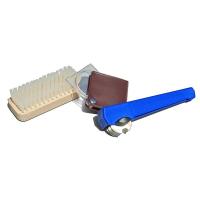
6. Use a soft brush to gently reciprocate five times along the two diagonal directions of the grid pattern.
7. The test is to be completed on at least three different positions of the test piece. If the test results of the three positions are different, the test shall be repeated on more than three positions, and all results shall be recorded at the same time.
Precautions
1. All cuts should penetrate the coating, but not too deep into the substrate.
2. If the coating is too thick and too hard to penetrate the substrate, the test is invalid, but it should be stated in the test report.
3. In special cases, it must be tested with the sticky tape method. The tape is generally 25mm wide translucent tape and pasted on the entire scratch board, and then torn off at the smallest angle. The result can be obtained according to the ratio of the peeling area of the paint film surface .
4. The test should be carried out at a temperature of 23°C±2°C and a relative humidity of 505%.
cross-cut grade
| grading | illustrate |
| 0 | The edges of the cut are completely smooth, with not a single square falling off. |
| 1 | There is a little flake separation of the coating at the intersection of the cut, and the cross-cut area is obviously affected by no more than 5%. |
| 2 | The coating loss at the edge or intersection of the incision is obviously greater than 5%, but the impact is obviously not more than 15%. |
| 3 | Part or all of the coating peels off in large fragments along the cutting edge, or partially or completely peels off on different parts of the grid, obviously greater than 15%, but the impact is obviously not greater than 35%. |
| 4 | Coating along the cutting edge, large fragments peel off, or some squares partly or completely fall off, obviously greater than 35%, but the impact is obviously not greater than 65%. |
| 5 | Severe flaking greater than category 4 |