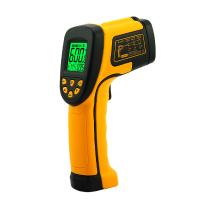
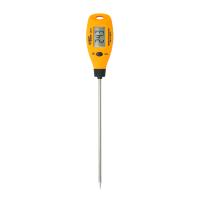
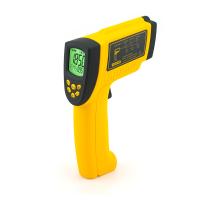
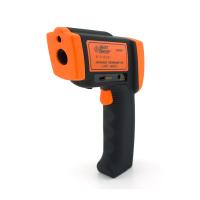
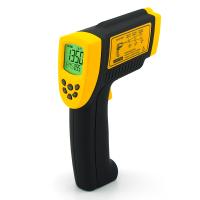
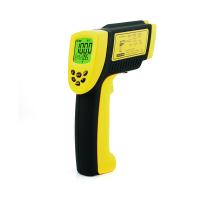
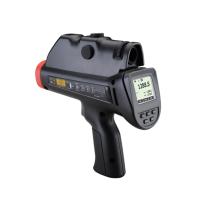
What is a Radiation Thermometer?
Infrared thermometers are a subset of devices known as "thermal radiation thermometers". Infrared thermometers (also known as pyrometers or radiation thermometers) are non-contact thermometers that measure the temperature of the human body based on the thermal radiation they emit. Infrared thermometers are also great for checking surface temperatures, however, they do not measure the internal temperature of an object. Infrared thermometers are very fast, typically taking a reading in a fraction of a second, the time it takes the thermometer's processor to perform the calculation.
What is the origin of the thermometer?
Santorii published an earlier record of thermometers in 1612. Gabriel Fahrenheit invented the first mercury thermometer in 1714. Infrared energy in the 1800's. Herschel knew that sunlight was made up of all the colors of the spectrum, so he wanted to explore these colors and their relationship to heat. He devised an experiment using a prism to spread light into the color spectrum and measured the temperature of the different colors using a thermometer with a blackened bulb. Herschel observed that the temperature increased from violet to red, and observed that the hottest temperatures actually went beyond red light. Herschel called radiation that causes heat beyond the visible red range "heat rays." Today, it is known as "infrared" energy. Over time, many versions were created until today's infrared version exists.
How does a thermometer work?
Infrared thermometers measure temperature from a distance. This distance can range from miles to fractions of an inch. Infrared thermometers are often used in situations where other types of thermometers are not practical. For example, an infrared thermometer is a great way to get the temperature from a safe distance if the object is very fragile or in close proximity to danger. Infrared thermometers work based on a phenomenon called black body radiation. At temperatures above absolute zero, any molecule moves internally. The higher the temperature, the faster the molecules move. As the molecules move, they emit infrared radiation, a type of electromagnetic radiation below the visible spectrum. As they heat up, they emit more infrared light and even start to emit visible light. This is why heated metal can turn red or even whitish. Infrared thermometers detect and measure this radiation. Infrared light works like visible light and can be focused, reflected or absorbed. Infrared thermometers typically use lenses to focus infrared light from an object onto a Detector called a thermopile. Thermopiles absorb infrared radiation and convert it into heat. The more infrared energy, the hotter the thermopile will get. This heat is converted into electricity. The electrical energy is sent to the Detector, which uses it to determine the temperature the thermometer is pointing at. The more electricity, the hotter the object. Thermopiles absorb infrared radiation and convert it into heat. The more infrared energy, the hotter the thermopile will get. This heat is converted into electricity. The electrical energy is sent to the Detector, which uses it to determine the temperature the thermometer is pointing at. The more electricity, the hotter the object. Thermopiles absorb infrared radiation and convert it into heat. The more infrared energy, the hotter the thermopile will get. This heat is converted into electricity. The electrical energy is sent to the Detector, which uses it to determine the temperature the thermometer is pointing at. The more electricity, the hotter the object.
Infrared thermometers are used in a wide range of applications. They are commonly used in industrial processes, professional fields and especially for monitoring mains power or measuring the temperature of components in motors or machines. The glass industry and the electrical industry use various forms of thermometers.
What are the advantages of using an infrared pyrometer?
Remote temperature measurement is possible without physical measurement. Infrared pyrometers are available in different spectral ranges and are especially manufactured with the application in mind. The compact electronics are digital and robust. Infrared pyrometers require little or no maintenance as they are not subject to wear and tear from harsh environments and high temperatures. Fast response time in milliseconds. Easy to handle and handle. Economical and offers more than it costs. Wide measurement range and wide temperature range. high precision. Remote installation is possible from a hot target. The temperature of a moving target can be easily determined. Useful in hazardous or inaccessible areas. Electromagnetic fields have no effect on infrared pyrometers. Do not contaminate, damage or interfere with the process.