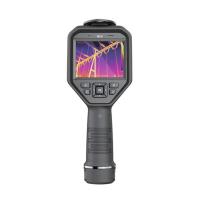
Thermal imaging, or infrared thermography, is a non-contact technology that measures or "sees" infrared wavelengths emanating from objects and then converts the temperature information into an image. A thermal image is characterized by a color palette representing a temperature range of the displayed image. Hot spots or elevated temperatures usually indicate a problem or potential failure. Thermal cameras are fully radiometric by measuring and storing the temperature at every point in the image.
Infrared wavelengths are too long for the human eye to detect. It's part of the electromagnetic spectrum that we perceive as heat. All objects with a temperature above absolute zero generate heat.
three key specifications
In the process of selecting a thermal imager, three main specifications cannot be overemphasized: temperature range, thermal sensitivity (NETD), and resolution.
temperature range
When selecting a thermal imaging camera, evaluate the appropriate temperature range for your application. For industrial applications, temperature range is the first specification to consider. Industrial thermal imagers have a wider temperature range to accommodate facilities with high temperature equipment such as boilers and steam systems.
thermal sensitivity (NETD)
Thermal sensitivity, or noise equivalent temperature difference (NETD), measures the smallest temperature difference a thermal imaging camera can detect in the presence of electrical noise. A camera with a low NETD will detect smaller temperature differences and provide higher resolution images with greater accuracy. Thermal sensitivity is measured in millikelvin (mK). The camera is more sensitive to lower values of the scale. For example, a camera with 50 mK is about 4 times more sensitive than a camera with 200 mK. A more sensitive (50 mK) camera provides a greater temperature difference, allowing more colors to be displayed on the thermal display.
resolution
The resolution of the Detector plays a role that cannot be overemphasized in the image quality of a thermal imaging camera. Higher resolution allows precise and reliable measurements of smaller targets from greater distances, creating sharper thermal images. The higher the Detector resolution, the more accurate the camera. When evaluating between Detector resolution and display resolution, please note that the quality of the thermal image and its data is always determined by the Detector resolution. For example, if the resolution of the built-in screen is 307,200 pixels (640 x 480) and the resolution of the thermal Detector is only 19,200 pixels (160 x 120), the thermal image can only be measured by the resolution of the thermal Detector. The example on the right shows that as the thermal Detector resolution increases,