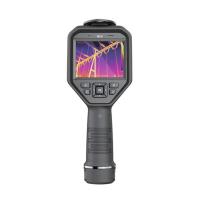
A thermal imaging camera, or TIC, can be a lifesaver for firefighters. Not only can they help firefighters navigate through smoky buildings, but TICs can also help them pinpoint the source of a fire so they can quickly and effectively extinguish flames. And because TICs can visualize heat, they're an important tool for search and rescue, hazmat operations, and more.
Choosing the right thermal imaging camera model can be tricky. This is often a complex exercise in comparing specs, including image resolution, camera sensitivity and temperature range. Firefighters sometimes track down the TIC that shows the maximum temperature range. It's not necessarily a good idea. In fact, there are good reasons why some thermal imaging cameras can only measure angles up to 1200 degrees.
The temperature range indicates the minimum and maximum temperatures the camera can measure. For example, FLIR's K-Series cameras accurately measure temperatures between -4 and 1202°F. Other brands will top out at over 2000°F, tempting the unwary buyer with "more is merrier" stories. While these numbers may seem staggering to equipment buyers, in today's professional thermal imaging technology, high temperatures come at the expense of image quality. For firefighters, image quality can make the difference between life and death.
Keep the following in mind about the high temperature range in the TIC:
1. Dangerous loss of image quality
The term "temperature range" is a bit misleading. Even more important to firefighters is the Effective Temperature Range (ETR), which measures the range of temperatures the TIC can see while still providing useful information to the user. Specifically, very high heat in the field of view tends to inhibit the TIC's ability to discern surfaces with intermediate temperatures and fine details. The reduction in image quality and contrast can have serious consequences for firefighters, as objects located in the lower temperature range (e.g. victims or escape routes) may be lost. Fire cameras typically have high-low ISO modes. In the absence of fire, the TIC will operate in a high-sensitivity mode detailing the thermal environment. In the event of a fire, the camera will switch to low-sensitivity mode, which offers a well-balanced compromise between lower sensitivity (less detail) and the ability to monitor higher surface temperatures. For FLIR's K-series cameras, the low sensitivity mode measures temperatures up to 1202°F. Measuring higher temperatures would mean switching to a lower sensitivity mode (third gain mode) where image detail and contrast can be sacrificed to measure higher temperatures, resulting in an unacceptable loss of image quality. A third buff mode may prevent firefighters from seeing victims, co-workers or escape routes, which is a serious safety and rescue concern. Provides a well-balanced compromise between lower sensitivity (less detail) and the ability to monitor higher surface temperatures. For FLIR's K-series cameras, the low sensitivity mode measures temperatures up to 1202°F. Measuring higher temperatures would mean switching to a lower sensitivity mode (third gain mode) where image detail and contrast can be sacrificed to measure higher temperatures, resulting in an unacceptable loss of image quality. A third buff mode may prevent firefighters from seeing victims, co-workers or escape routes, which is a serious safety and rescue concern. Provides a well-balanced compromise between lower sensitivity (less detail) and the ability to monitor higher surface temperatures. For FLIR's K-series cameras, the low sensitivity mode measures temperatures up to 1202°F. Measuring higher temperatures would mean switching to a lower sensitivity mode (third gain mode) where image detail and contrast can be sacrificed to measure higher temperatures, resulting in an unacceptable loss of image quality. A third buff mode may prevent firefighters from seeing victims, co-workers or escape routes, which is a serious safety and rescue concern. Measuring higher temperatures will mean switching to a lower sensitivity mode (third gain mode) where Higher temperatures are measured at the expense of image detail and contrast, resulting in an unacceptable loss of image quality. A third buff mode may prevent firefighters from seeing victims, co-workers or escape routes, which is a serious safety and rescue concern. Measuring higher temperatures would mean switching to a lower sensitivity mode (third gain mode) where image detail and contrast can be sacrificed to measure higher temperatures, resulting in an unacceptable loss of image quality. A third buff mode may prevent firefighters from seeing victims, co-workers or escape routes, which is a serious safety and rescue concern.
2. The myth of predicting flashovers
Thermal imaging cameras are sometimes thought to be able to predict flashovers. they are not. Arcing occurs when the air temperature exceeds 932°F. However, even with a TIC that measures above 932°F, you will not be able to predict flashovers because the thermal imaging camera will detect differences in surface temperature rather than air temperature. There is no black and white answer as to why the flashover occurred. Flashovers are difficult to predict and may not occur even when desirable/typical flashover conditions exist. Thermal imaging cameras may be helpful in identifying pre-flashover conditions through sound image interpretation. But for now, the way to prepare for an impending fire jump is through exhaustive firefighter training,
3. Predict melting of steel structures?
Thermal cameras are sometimes said to predict when steel will start to melt and bend. This is especially useful in fire scenes of industrial buildings, often with steel frames. However, this is still very difficult. Even with a thermal camera that can go up to 2,000°F, you won't be able to get an accurate temperature since the melting point of steel is actually much higher (about 2,500°F). Can my FLIR TIC survive higher temperatures? FLIR K-Series cameras will not experience a temperature difference greater than 1202°F. Instead, red is used to warn firefighters of immediate danger. In this case, the FLIR TIC will simply indicate ">1202°F" on the display without sacrificing image detail while maintaining a well-balanced low sensitivity mode. K-Series TICs are designed to withstand the harshest fire conditions. They can be dropped 2 meters onto concrete, are water resistant (IP67), and can operate in temperatures up to 500°F for five minutes. The K65 is fully compliant with the NFPA 1801:2013 standard for fire protection cameras.
So when does the high temperature range make sense? Unlike the TIC used for fire protection, high temperature readings are indeed required in many applications. In industrial and manufacturing environments, FLIR thermal imaging cameras are used to observe flames and monitor the refractory quality of boiler and furnace facilities. High temperature performance is important in certain R&D environments such as microelectronics, automotive, plastics and mechanical testing.