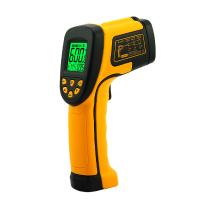
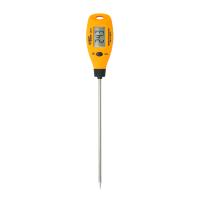
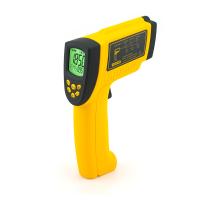
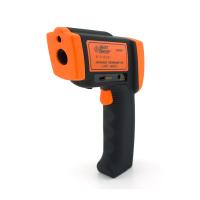
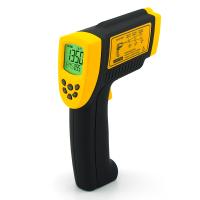
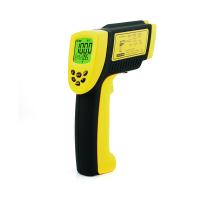
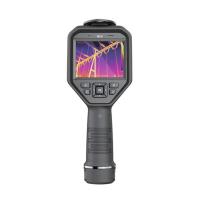
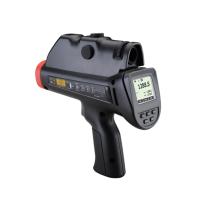
The importance of temperature measurement to the glass industry.
The importance of temperature measurement to the glass industry cannot be overemphasized as it relates to the high energy processes involved in glass manufacturing. Temperature measurement improves efficiency by maintaining uniform quality and reducing the amount of waste in the glass factory. To improve process control, temperature measurements are taken at several stages throughout production, including the manufacture of various glasses such as float glass, fiber glass and industrial glass.
Advantages of Infrared Pyrometers.
No physical contact required as remote measurements can be made
Pyrometers are available in different spectral ranges depending on application needs
Robust device and fully digital interface with compact electronics
Requires little maintenance as they are not subject to the wear and tear of high temperatures and exposure to the environment
Fast response time (in milliseconds)
Easy handling and operation
cost effective and very good delivery
Capable of measuring various temperature ranges
highly accurate
Remote mounting possible from thermal target
Moving target temperature is easy to detect
Ability to use in inaccessible or dangerous places
Electromagnetic fields have no effect on infrared pyrometers
Will not interfere with, damage or contaminate the process
The Role of Wavelength or Spectral Range in Pyrometer Selection
Glass behavior changes as a function of wavelength, making wavelength selection imperative for glass applications.
Around visible wavelengths in the infrared region, glass is transparent. In the spectral range of 5…5.14 μm, the temperature of the glass surface can be precisely measured because the emission is very high and the reflection is almost zero. The AL 514 infrared pyrometer is the recommended product for this spectral range, more suitable for float glass temperature measurement.
No light penetrates at 8-14 μm, which means the glass is completely opaque. The reflectivity is about 20%, so when the reflectivity is 0.2, the 8-14μm range can be used at an emissivity setting of e = 0.8 (1.0-0.2). This range is especially useful for measuring the temperature of bottles and thin glass plates. However, if there are flames or hot objects around the glass, it may affect the readings of pyrometers in this range.
For molten glass temperatures, a spectral range of 1 µm is recommended. This is because light can penetrate distances down to certain centimeters, which helps to measure glass temperature to some extent under the surface of melting tanks, feeders and forehearths.
Float glass application
The melting temperature of the furnace is 1500°C, where the raw materials are fed into the furnace. The molten glass is then moved through canals to tin baths. The glass then floats on the surface. As the glass flows through the tin bath, the temperature drops from 1100°C to 600°C. After the glass leaves the tin bath, it reaches the annealing furnace and cools down so that the glass has strain resistance and will not break, and the clear cutting ability of the glass is good. After the glass has been annealed, it leaves the annealer where the glass is cut and transported.
The importance of float glass temperature measurement in working Water Tanks, water channels, tin baths and annealing furnaces goes without saying.

1-Application: working tank
Processing temperature: 1500°C
2- Application: Canal
Process temperature: Before entering the bath, the temperature needs to be at least 1100°C
3- Application: tin bath
Process temperature: Starts at 1100°C and leaves the float bath at 600°C as a solid ribbon. As the glass flows down, the temperature of the tin bath is reduced to 600°C
Installation of infrared pyrometer: The infrared sensor should be installed above the tin bath
4- Application: Annealing annealing furnace
Processing temperature: 100°C-800°C
Installation of infrared pyrometers: Infrared sensors will be installed at the same location above the entire kiln
Container glass application
Bottles, jars, bowls, and glass items designed to hold their contents are generally considered container glass. The fabrication process involves transferring molten metal from a working tank to one or more hearths/feeders. The molten glass then flows from the drop point into the gob and into the mold where it is ready to be shaped.
The importance of precise temperature control in the forehearth/feeder cannot be overemphasized. Controlling the temperature will ensure that the molten glass reaches the gob in a uniform state. The importance of temperature changes on glass viscosity is self-evident, and only small temperature changes can affect viscosity.
1-Application- Working tank
The importance of temperature measurement to maintain a homogeneous state of the molten glass in the tank goes without saying.
2-Application- Feeder/Forehearth
The 450 G-2 is an infrared pyrometer suitable for measuring fore furnace temperatures. Fast response times allow changes in temperature range to be easily monitored. The pyrometer has a small optical head, allowing it to get into the most difficult-to-reach places. Fiber optic cables can withstand high temperatures of 250°C. Accessories (especially air purge units) can also be used to help keep optical lenses clean.
Application - Glass Frit
To achieve the desired wall thickness of the glass container, temperature management is required. Infrared pyrometers ensure that the correct gob temperature is reached before proceeding to the next stage. Container glass manufacturing requires responsive equipment. The two-color pyrometer has a response time of 20 milliseconds, making it a suitable choice for container glass manufacturing. A pyrometer with a water-cooled jacket is a good choice for this application.
Application - Glass Mold
The A 250 Single Wave Infrared Digital Pyrometer with peak value collector and software for continuous data storage is a good choice for this application.