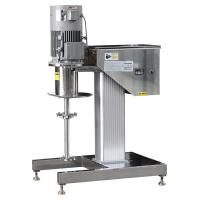
Blending is one of the common industrial processes practiced in many industries including chemical, plastics, metals, minerals, food processing and more. Industrial mixers often play a role that cannot be overemphasized, even when handling large volumes of difficult materials. With the vast selection of industrial machinery on the market, finding the right equipment can seem overwhelming. In this article, we'll discuss the main factors to consider when choosing the right mixer.

To narrow down your options, here are a few things to keep in mind when deciding which industrial mixer fits your needs.
Determine container capacity. Explore batch height, tank height and target mixing vessel diameter. This means you should determine if your mixing equipment is capable of handling the required amount of material.
Determine the type of fluid viscosity you are using. Different kinds of liquids exhibit different properties when force is applied. When selecting a mixer, it is important to properly classify the type of liquid that will be used in your application, as well as its viscosity. Here are four common liquid behaviors:
Thixotropic Liquids - These liquids decrease in viscosity when agitation is increased. Examples include peanut butter, ink, glue, shortening, tar, and soap.
Swelling Fluids: When a shear force is applied, the viscosity of the fluid increases. Examples: candy compounds, clay and slurries.
Pseudoplastic liquids: This is the opposite of a dilatant; the more shear is applied, the more viscous it becomes. Common pseudoplastic liquids include ketchup, paint, latex, gels, and lotions.
Newtonian Liquid: The viscosity of a Newtonian liquid remains constant regardless of the mixing rate. These fluids have a linear relationship between viscosity and shear stress. May include hydrocarbons, mineral oil and water.
Measure your torque requirements. Consider the amount of rotational force required by the blender motor, given the type of liquid you will be using. Usually in pounds. or oz.
The efficiency of the motor in the mixer can be expressed as:
hp = (inch ounces x rpm) / 1,008,400
Speed and impeller size. This is important because slight adjustments in the diameter of the impeller can seriously affect the desired mixing power. This is derived by using the following formula:
Power = RPM3 X dia5 (rpm to the 3rd power of the 5th power of diameter)