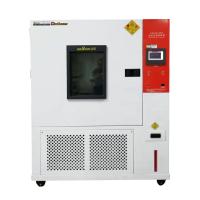
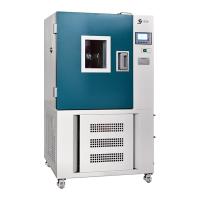
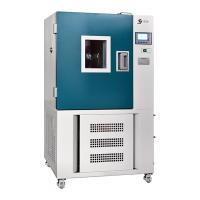
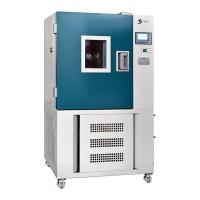
The high-low Temperature Test Chamber is suitable for the adaptability test of welders, electronic equipment, instruments and equipment and their products, spare parts and raw materials in the storage, transportation and application of high temperature and low temperature alternating electric fields in cold and humid natural environments. It is an engineering reliability test equipment for low temperature, high temperature, water resistance, dry resistance test and quality control of various electronic equipment, electric welders, household appliances, plastics and other raw materials and parts; it is very suitable for optical fiber, liquid crystal display, crystal , Inductors, pcb circuit boards, rechargeable batteries, computers, mobile phones and other products of heat, temperature, humidity and cold cycle system experiments.

Therefore, to ensure testability in the wild, one needs to calibrate its properties. At this stage, the keys can be selected in several different ways throughout the calibration process. In the actual calibration, people need to at least choose the appropriate method to calibrate the high-low Temperature Test Chamber according to the specific situation.
And willing to ensure the accuracy of the selection, one needs to first have some understanding of these different types of corrections, the pros and cons of each in analysis and scientific research. The temperature shock chamber manufacturer provides a detailed description of the advantages and disadvantages of these different calibration methods in common environmental Test Chambers:
The first calibration is the key to correcting under zero load conditions.
In contrast, the main advantage of this approach is that it can be calibrated for all working areas in natural environment tanks and allows a reasonable assessment of the acceptability of the Test Chamber. And after removing the test sample, there is no need to perform calibration again.
So, what is the downside of this correction? One thing is that one cannot immediately know how the test sample will damage the characteristics of the high-low Temperature Test Chambers.
The second method of calibration is to perform the calibration under load conditions.
In contrast, the advantages of this calibration method are outstanding, including: it can accurately detect the damage of commonly used samples to the characteristics of high-low temperature Humidity Chambers, which is beneficial to obtain key natural environment experiments. part of the test sample. detail. This method is also a drawback, for example, it needs to be corrected again after the test sample is taken out.