What is thermal shock testing?
A product's adaptability to rapid and extreme changes in temperature will require a durability test called a thermal shock test.
Any kind of product or equipment can be exposed to relatively hot weather conditions, i.e. too hot or too cold.
Such exposure may alter or alter the product's performance and impair its ability to bond itself together, which may cause the product to crack, crack or bend.
Take vinyl leather, for example, which usually comes in the form of a bag or coat.
When vinyl leather is exposed to changing weather in rapid succession, the properties of the leather degrade, altering its structural performance, strength and longevity.
To combat this, manufacturers perform thermal shock tests to find out how well a product can withstand changes in the weather.
The performance of thermal shock testing involves rapid changes in extreme temperatures from hot to cold and vice versa.
This test typically uses a temperature of 15°C per minute or higher, which is the test temperature for goods to be shipped or distributed.
Products could be military parts and equipment, aviation parts, product packaging, or even rough-used electronics.
Subjecting these products to thermal shock testing can really help determine their ability to withstand rapid changes in weather.
Just imagine the devastation that could be wrought if an aircraft part could not withstand rapid changes in weather and it would crack and blow up the entire part.

Applicable test standard for thermal shock
``MIL-STD-810 This is the U.S. military standard used by changing the test limits for the eco-design of a product or device and the conditions that a product needs to experience during its expected lifetime.
Although it is primarily used for military purposes, it is also widely used in commercial products.
This test employs a thermal shock chamber, in which the effects of the environment are replicated or simulated on the equipment, rather than the manufacturer modeling the environmental conditions normally itself surrounding the product.

Purpose of Thermal Shock Test
``There is a growing demand for thermal shocks in various industries due to the following factors:
- Reduced parts count and less equipment make it more susceptible to heat
- Production processes may generate extremely high heat, such as reflow soldering
- Higher demands on product precision create thermal stress during production
- New innovations in the automotive industry aimed at reducing the weight of vehicles and making them stronger will require more information on how these new components withstand extreme changes in temperature
- Rapid changes in temperature (especially in the engine compartment) and the machine under the hood.
Conduct Thermal Shock Test
当正在执行的热冲击测试,重要的是要首先仔细辨认上部和较低的温度。按照棺材-曼森方程,较大的差是在测试室的温度之间相比于正常使用温度产品将导致更高的加速因子。话虽如此,更好选择不超过产品操作极限或其性能极限的正确温度极限。
例如,如果选择的最高温度超过或超过产品任何成分或材料的熔点,则测试结果很可能是不准确的。主要思想是确保在测试过程中正确测量温度(低温和高温),并确保进行仔细的监控,并且将热电偶放置在样品或产品周围的位置正确。产品或样品的热质量,样品数量以及样品周围的空气流动(高度取决于腔室中样品的间隔)是可能影响测试参数的因素。
测试要求中还应包括产品或样品需要暴露于各种温度下的时间,以及产品在低温和高温下的公差。
测试方法可以指定最低温度变化率。经受热测试的产品可以带电或不带电。对于供电的产品,更长的电缆将需要做好准备,以便电缆可在室内外达到,但可以适合通过室坑洞。
热冲击腔的类型
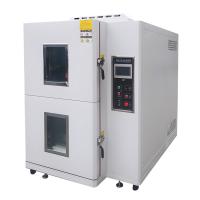
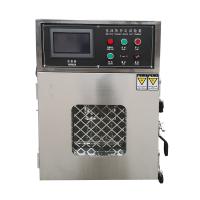
通常热袜子室可分为2种类型,即3-区和2-区室休克。该分类由腔室的结构定义。
热冲击腔室还可以According to其使用的测试介质(即空气和液体)进行分类。本文将不再讨论。将来我们可能会分享更多。
空对空热冲击腔被广泛使用。我们在这里仅涉及这种类型的腔室。
3-区热冲击室
的三个区热冲击室是合适的用于测试一整套暴露于在温度急剧变化的产品,材料和部件,以及组件。
事后看来,这意味着该腔室可容纳较大的产品或样品。
三区热冲击腔包括用于预冷却的低温区域,用于预热的高温区域和放置样品的测试区域。
在此测试中,将样品放在室内(测试区域)中,同时空气温度快速升高和降低(快速冷却和加热),然后采用独立的风路切换模式将冷热空气转移到测试区域确保在过程中产品或样品静止不动时温度变化迅速。
在此过程中,整个腔室先冷却后再加热,与两个区域的热冲击腔室相比,腔室温度变化的速度要慢一些。
2区热冲击腔室
两区热冲击腔室设计用于较小的产品或样品。它在升降机机构上工作,该升降机机构也限制了要测试的产品或样品的重量。
The chamber has two separate chambers (hot and cold chambers) and a lift mechanism is used to transport products or samples between two or more Test Chambers placed in portable baskets.