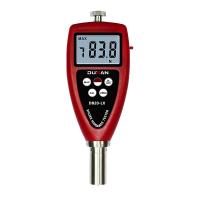
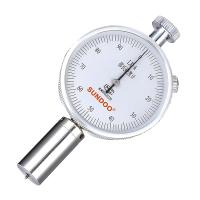
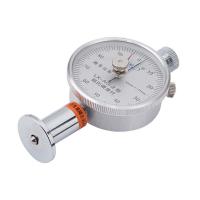
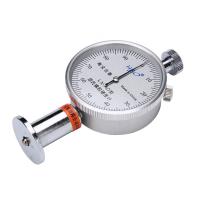
Hardness can be defined as the resistance of a material to indentation. The hardness scale was defined by Albert Ferdinand Shore. The instrument as well as the unit of measurement is called a durometer. Durometers are used to measure the hardness of polymers, elastomers and rubbers. Today, the name usually refers to Shore hardness. Shore hardness is one of several methods of measuring the hardness of a material.

Shore hardness has different scales that can describe the hardness of different types of materials. According to the type of use, the Shore hardness is divided into 12 different scales, namely: A, B, C, D, DO, E, M, O, OO, OOO, OOO-S and R. Each scale has values ranging from 0 to 100. The higher the value, the harder the material and vice versa. Often there is overlap between ticks where one tick ends and another begins.
Shore hardness generally indicates the hardness or durometer of a material. The Shore 00 scale is used for ultra-soft materials, while the Shore A scale is used for soft materials. Shore D, on the other hand, is used for rigid materials. As you can see from the image, a Shore hardness of 20 A corresponds to a rubber band. Such is the softness of the material corresponding to the Shore 20 A. Please note that here we are not referring to the elasticity of the rubber band, but its hardness value! The rubber band is very soft. If you were to apply force to it with the tip of your fingernail, you'd most likely make a nail-shaped indentation in the strap. In 3D printing, we offer a material called Tango-elastic that can simulate hardness values from Shore 27 A to Shore 85 A. So basically, it can be as soft as a rubber band or as hard as a shoe heel.
On the other hand, we also offer rigid and rigid materials called glass-filled nylon in 3D printing. It is a nylon reinforced material filled with 30% glass. It has a Shore hardness of 80 D, which means the material is as hard as a hard hat. In 3D printing we typically deal with materials that simulate hardness properties on a scale from Shore A to Shore D. You can find a list of all the 3D printing materials we offer here.
To reiterate, hardness is a material property which is defined as resistance to indentation. This is by no means an indication of how strong your part is or how well it will perform. In addition to material properties, part performance and desired output have a lot to do with part design. You can contact us to ensure that your 3D CAD design is 3D printable and meets all material design guidelines required for sound output.