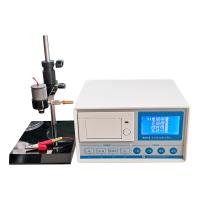
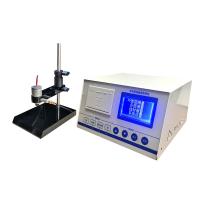
Surface Profile Depth Micrometer (Method B of ASTM D4417)
The depth micrometers described in the ASTM standard contain a spring-loaded 60° tapered pin protruding from the bottom of the instrument. The bottom of the instrument rests on the peaks of the surface profile, and the pins reach into the valleys. The distance the cone projects into the valley is displayed in 0.1 mil increments; the reading can also be displayed in microns (µm).
Step 1 – Set up the instrument onto a piece of flat glass supplied with the gauge (which has been ground flat to remove waviness) and place a horseshoe spacer (also supplied with the gauge) on the flat glass. Measure the thickness of the shim to verify the accuracy of the gauge.
Step 2 – Place the gauge over the probe and push it firmly against the surface to be measured. Record the reading. Readings can also be stored in memory and uploaded or printed at a later time.
Step 3 – Pick up the gage and reposition it on the surface to take another reading. Don't drag it across the surface, as dragging will dull the blunt tip.
Step 4 – Take at least 10 readings at each test location. The maximum value of 10 readings (excluding obvious outliers) represents the contour of the location.
Surface Profile Replication Tape (Method C of ASTM D4417)
This tape is used to create a replica of the surface profile, which can be measured with a light spring-loaded micrometer. An instrument manufacturer also developed an accessory for digital gauges to read duplicate tapes and store the results electronically. The following instructions are for measuring replica tape with a spring micrometer.
Step 1 – Select a replica tape that covers the expected profile range. The tape is mid-range to be exact:
Coarse – 0.8 to 2.5 mils
X-Coarse – 1.5 to 4.5 mils
X-Coarse Plus – 4.0 to 5.0 mils
Step 2 – Prepare the area to be tested by removing surface dust or contamination. This can be done by brushing your teeth.
Step 3 – Remove the paper backing from the tape. The measurement area consists of a 2.0 mil thick Mylar® (polyester) film that is covered with a thin layer of compressible foam. Foam conforms to the depth and shape of surface contours.
Step 4 – Apply copying tape to the surface and polish the back of the white mylar circle (3/8" diameter) with a polishing tool. See Figure 3.
Step 5 – Remove the tape and place it in the anvil of the micrometer. The surface profile is the total reading minus 2.0 mils (2.0 mils is the thickness of the mylar that holds the compressible foam). Alternatively, if the micrometer is set to -2.0 mils prior to inserting the tape into the anvil, the displayed reading will be a direct indication of the surface profile. Two readings are taken at each location and averaged to determine the surface profile.
NOTE – If the surface profile measured with thick tape is 1.5 to 2.5 mils, the same area will need to be measured with X thick tape. If that reading is also between 1.5 and 2.5 mils, average the two values to determine the surface profile depth. If the second reading using X Coarse Tape is greater than 2.5 mils, record this value as Surface Profile.
Surface Profiles – Concrete (ICRI 310.2R-2013)
ICRI Guideline No. 310.2R-2013, "Selection and Specification of Concrete Surface Preparations for Sealants, Coatings, and Polymeric Overlays, and Concrete Repair," describes concrete surface preparations in writing and through the use of the Tactile Concrete Surface Profile (CSP) Methods. ) specimen, which is a copy of the type of profile (surface roughness) created by various surface treatments. While many standards address the roughness of floor surfaces, some methods apply to surfaces other than floors. The texture of the specimens ranged from very smooth, typical of pressure washing (CSP1) to very rough, typical of hammering (CSP 10):
Detergent Wash – CSP1
Low Pressure Water Cleaning – CSP1
Grinding – CSP1-CSP2
Acid Etching – CSP1-CSP3
Needle Calibration – CSP2-CSP4
Sandblasting – CSP2-CSP7
Shot blasting – CSP2-CSP9.
High/Ultra High Pressure Water Jetting – CSP3-CSP10.
Scarifier – CSP4-CSP7
Hobbing – CSP6-CSP9.
Scratch – CSP7-CSP9.
Handheld Concrete Breakers – CSP7-CSP10
Step 1 – Determine the surface preparation method required by the specification or manufacturer.
Step 2 – Select a concrete surface profile specimen that represents the texture or range of textures that can be created in accordance with the 310.2R-2013 guidelines. See photo 4.
Step 3 – Compare the prepared surface to the test specimen to determine if the roughness is acceptable.