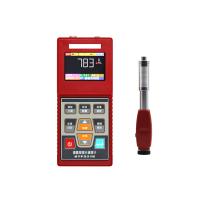
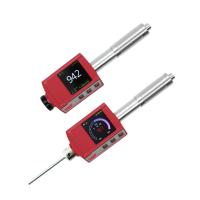
The ability of any particular object or substance to resist indentation when a force is applied is called hardness. The hardness of an object should be classified as a feature or characteristic rather than as one of its properties, and is usually measured by calculating the permanent area of the indentation caused by a fixed load.
Hardwell and Brinell tests are two specific methods of measuring hardness.
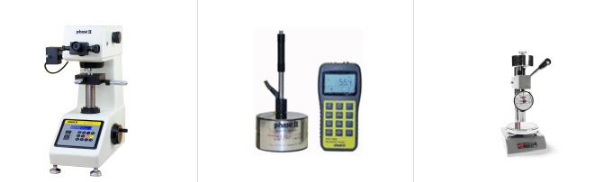
rockwell test
The Rockwell test is the easier of the two methods and tends to be more accurate. It can be used to test a wide variety of metals including hard metals (unlike Brinell hardness testing), except where external factors can affect it.
It also happens to be a commonly used test.
The Rockwell test uses specific procedures to measure hardness. Unlike Brinell testing, it uses a smaller indenter, such as a diamond. This indenter is used to apply a small load (load/force will be increased later) to avoid cracking the surface of the material. This method has proven to be less destructive than the Brinell test.
Vickers test
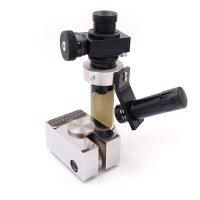
Vickers testing is ideal for testing materials that do not require as much load/force but provide increased accuracy during testing. Equipped with the pointed tip of its diamond indenter, the Vickers test also utilizes an optical system that magnifies a targeted area of the material.
This magnification capability allows the Tester to focus on trace elements on the surface and therefore be more accurate. This is very different from other tests.
However, compared to the Brinell and Rockwell tests, the Vickers test is more expensive due to the preparation required and the cost of obtaining the optics. The testing process also takes more time than the Rockwell test.
Brinell test
The Brinell hardness test method happened to be the first test method to be widely used. It is commonly used to measure the hardness of metallic materials, with particular preference for rough materials.
It could also be that the material simply isn't suitable for other tests, so the Brinell test is the only way to determine hardness.
However, the Brinell hardness test is not suitable for materials that have been overhardened, of which hardened steel is one of the obvious examples.
Beyond that, the method is slow compared to other tests and tends to leave irreparable marks on metallic objects or materials.