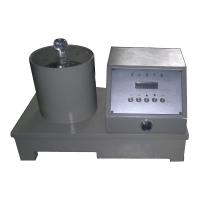
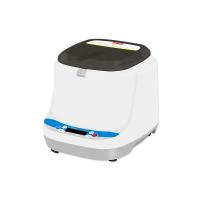
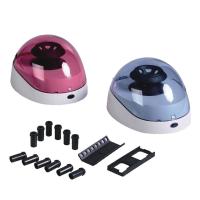
A centrifuge is a machine that separates particles according to their size, shape, density and viscosity of the medium by placing them in an artificially induced gravitational field. This can be used as a preparative method to separate complex mixtures present in a sample or analytically to determine the mass, shape or density of particles. The higher particle density material will settle towards the centrifuge axis (down the centrifuge tube), while the lower particle density material will settle down towards the centrifuge axis. Cells, subcellular components, viral particles, and precipitated forms of proteins and nucleic acids are commonly isolated by this method.
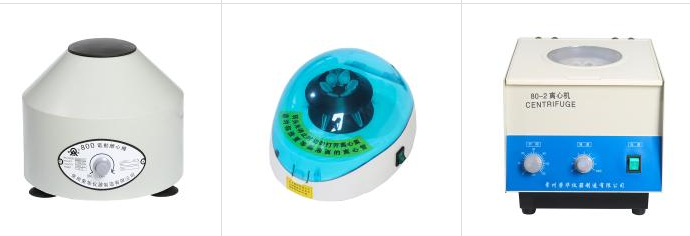
The centrifuge mainly works on the principle of settling, in which the acceleration of the centripetal force causes the denser substances to separate out along the radial direction at the bottom of the tube. The word "centrifugal force" is derived from two Latin words: centrum, meaning "center," and fugere, meaning "to escape." Basically it is the apparent force that pulls the rotating object away from the center of rotation, caused by the object's inertia as the object's path keeps changing direction. The acceleration obtained by centrifugation is expressed as a multiple of the Earth's gravity (g). According to their achievable acceleration values, centrifuges are divided into benchtop (up to 15000 g), high-speed refrigerated centrifuges (50000 g) and ultracentrifuges (500000 g). Because ultracentrifuges can operate in cold conditions and under vacuum, they are ideal for separating large molecules such as proteins, nucleic acids, and carbohydrates. The radial force produced by a rotating rotor can also be expressed relative to g as relative centrifugal force (RCF) or g-force.
A centrifuge has three basic components, the rotor, drive shaft and electric motor. The rotor can be mounted on a drive shaft which connects it to the motor. An electric motor provides power to spin the rotor. Typically, a safety cabinet surrounds and supports these components. The sample is placed in a reinforced plastic tube, which is then held in a rotor that rotates around its main axis. Rotors are usually made of strong materials such as aluminum alloy or stainless steel. To better reduce vibration and strain on the shaft and bearings, a loaded rotor should be well balanced, that is, its total mass should be distributed around the axis of rotation so that the resultant of all fundamental forces is zero.
There are two main types of rotors available:
Fixed-angle rotors: The sample tube is placed in a machined hole in a metal rotor that is at a fixed angle (typically 45°) relative to the vertical axis of rotation. During centrifugation, this angle is kept constant and the pellet rests against the side wall of the tube.
Swinging Bucket Rotor: Place the sample tube in a holder suspended from the rotor. When a centripetal force is applied, the holder swings outward so that it is level with the horizontal axis of the rotor, and particles are acquired at the bottom of the tube.
Oscillating barrel rotors are preferred over fixed angle rotors since the particles are obtained from the bottom. However, the salient features of fixed-angle rotors, such as simple and effective tube spacing, ability to accommodate more tubes, rigid design of materials, and ability to withstand higher g-forces, generally make them a desirable choice.
Depending on the type of application involved, it is also possible to choose from different types of centrifugation, such as density gradient centrifugation, microcentrifugation, rate zone centrifugation and isobaric centrifugation. Regardless of the application and rotor design, centrifugation plays an important role in separating macromolecules and molecules in solution and is a required part of any laboratory.