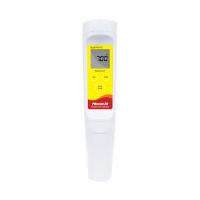
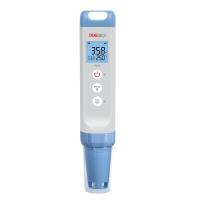
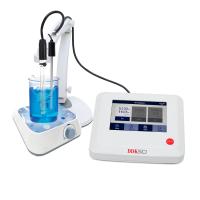
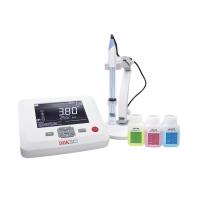
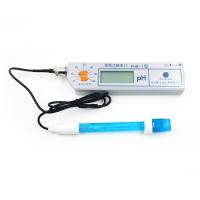
There are a variety of pH Testers on the market, each designed with a different application in mind. To choose a good pH Tester, it is important to know which features to look for based on your intended use.
We've outlined some common features of pH Testers and explained why they are relevant in different situations to help you narrow your search.
Choose the right model for your needs
The oldest and most basic method of pH testing involves the use of litmus paper. Litmus strips are sold in packages or bundles designed to be used once and discarded. The strips change color depending on the pH of the substance they're immersed in, indicating whether the substance is acidic or basic. Because the results are qualitative (observable) rather than quantitative (measurable), litmus paper cannot accurately determine how acidic or basic a substance is. Since comparing a used strip to a color chart is more subjective, results are also more likely to vary between users.
Today, pH Testers and meters have largely replaced traditional litmus paper as a more reliable, sustainable, effective and accurate alternative. Digital pH Testers come in many shapes, sizes and levels of complexity. As you search for the perfect pH Tester and compare different products, here are some key factors to keep in mind:
Temperature compensation
You may ask, why do you need to read the temperature on a pH Tester? The pH of a substance is directly affected by temperature, so getting consistent and accurate pH readings requires knowing the temperature of each reading. Generally, when the temperature of a substance increases, its pH decreases.
Although it is possible to use a thermometer to measure temperature and a separate Tester to measure pH, more advanced pH Testers can provide both functions in one tool and can be used with automatic temperature compensation (ATC) or solution temperature compensation (STC ) to help the user account for temperature differences. . ATC is calculated automatically and does not require pH to be obtained at the same temperature. Instead, STC requires better temperature consistency between readings and/or between manually entering temperatures into the Tester. If you're looking for more consistent, accurate pH readings without extra time or computational effort, you can use a dual pH and temperature Tester with ATC that automatically compensates for temperature and reduces the chance of human error.

Portability and Durability
If you plan to use your pH Tester outside of the lab, it is important to choose a Tester that is portable, lightweight, durable, and easy to hold. Also, consider the environment you will be working in and the wear and tear the Tester may be subject to. If you're testing water in a rough environment, you can choose a meter that's durable enough to withstand minor shocks and designed to be resilient to moisture, dust, and other natural elements. As with any portable meter, it is also important to consider readability (is the screen backlit for easy viewing? is it legible?), and ease of use (can it be operated with one hand? is it easy to browse the data?). ), and battery life.
If you don't want to carry a pH meter around, or need to frequently take readings from the same location, a benchtop meter or online monitor may be better for your purposes. Like portable Testers, benchtop meters and in-line monitors range from basic to very sophisticated. When comparing models, consider what level of insight and functionality can help you achieve your goals.
Data Storage, Accessibility and Shareability
One of the greatest benefits of digital pH meters is their ability to store and retrieve archived data. More advanced pH Testers can save calibration information and have date and time stamped readings for easy retrieval and analysis. Choose a meter with rugged memory storage if you want to save and compare readings for extended periods of time, or if you want to collect a large number of data points without constantly cleaning the device. In addition to internal memory, some meters feature Bluetooth or cloud compatibility, making it incredibly easy to store, browse, share and analyze data from remote locations. The Bluetooth compatible Tester combined with a smartphone app allows users to automatically view pH and calibration results, browse data, and customize field settings using a more comprehensive and familiar interface. Smartphone-compatible devices can also provide other benefits, such as GPS tracking and mapping to assign a geographic location to each data point.