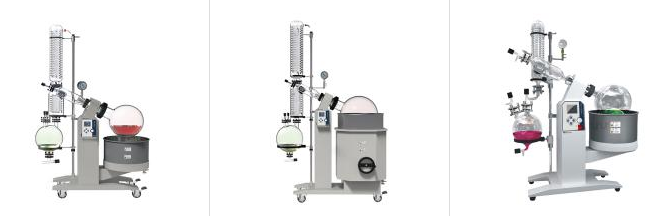
Vacuum is an essential part of a rotary evaporation system. During use, it is equally important to ensure that the system is functioning properly and "holding vacuum", in other words, maintaining pressure and not leaking outside air into the system. There are many reasons why the system might not be able to maintain a vacuum.
If a problem is found or expected, the first thing to check is that the vacuum is maintained when there is no liquid in the system. In theory, this should be a closed system that cannot produce more gas through evaporation. If the system is shut down and the pump is functioning normally, the pump's max vacuum/minimum pressure should be reached relatively quickly. (If applicable, the next two paragraphs can be skipped.)
If not, check the integrity of the pump. You can disconnect the pump and use a vacuum gauge (with a closed line on the end) directly on the pump to see how it's doing. If it is not possible to add air to the system (e.g. through leaky fittings or connections), the Vacuum Pump should be able to reach its maximum vacuum/minimum pressure quickly.
Next, check the system for leaks. Leaks usually occur at joints, but can also be caused by cracked or damaged glassware or other parts. Leaks can also occur between the condenser and the seal near the upper end of the vapor tube where it connects to the valve body of the rotary evaporator. Sometimes you can put your ear near glass seams and connections to listen for leaks, but many times the Vacuum Pump is loud enough that small leaks cannot be detected this way. Remove and reconnect all fittings and connections. If necessary, you can remove and replace each item one at a time, testing after each connection by plugging or plugging the open fitting upstream to try to isolate the wrong connection or part.
If the pump is in good working order and you cannot find any leaks, but the system still does not maintain a constant vacuum during evaporation, check the conditions for evaporating solvent. The conversion from liquid to gas involves an enormous increase in volume. At standard temperature and pressure, 1 mole of gas = 22.4 liters. For example, this means that 18 ml of H2O (1 mole) converts to 22.4 liters of gas. The same goes for 104 mL of diethyl ether, 64 mL of dichloromethane, and 132 mL of hexane. However, at lower pressures, a small amount of liquid turns into a large amount of gas. For example, at one-tenth of standard atmospheric pressure (0.1 atmosphere or 101 millibars), the same 18 milliliters of water would turn into about 224 liters of gas. This is due to Boyle's law, which states that the pressure of a gas is inversely proportional to the volume of the gas. Less pressure means more volume, and many rotary evaporator applications operate at very low pressures.
The rate of gas produced due to evaporation is important because all Vacuum Pumps have a maximum volume of gas that can be removed per unit of time. This means that if the liquid is evaporated at a high enough rate, more gas will be produced than the pump can remove. More gas in the system increases the pressure. If this is the case, you will see a drop in pressure towards the end of the evaporation process as the evaporated gas decreases and eventually stops. If your system is showing signs that the pump is not keeping up, you have two options: you can deal with a process that is slower than it would otherwise be, possibly due to a slower than good evaporation rate, or you can get a more Sturdy pump.
Note that the headroom of a pump generally decreases as it approaches its minimum pressure. So, for example, a VP18R Vacuum Pump has a rated headroom pressure of 18 L/min and a minimum pressure of 20 mbar. But it doesn't clear 20 L/min of gas when the pressure is at or near 20 mbar. You should be able to obtain these pump curves from the laboratory supply network or from the manufacturer upon request.
Vacuum is an important part of the rotary evaporation process. Being able to spot any stress-related issues quickly and efficiently will help you run more efficient processes and better reduce downtime.