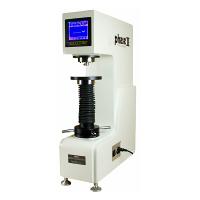
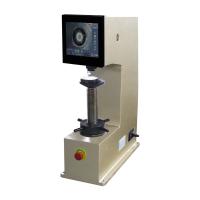
The hardness of a material is defined as the resistance of a particular material to localized plastic deformation or indentation. The term can also be used to describe a material's resistance to scratches, abrasions, or cuts. For metals, hardness is commonly used to assess its ability to resist permanent deformation due to concentratedly applied loads. The harder a metal is, the better its ability to hold its shape under external force.
The hardness of metals depends largely on other parameters such as stiffness, strength, strain, ductility and yield strength. Knowing the hardness of a metal is useful as it helps in choosing the right material for a particular application. Prior knowledge of the metal's hardness is helpful in assessing how easily a metal can be machined or how it will behave in operation. (For more information on how proper material selection can prevent corrosion, read How to Control Corrosion Through Improved Design.)
Hardness Test Method
Unlike other well-defined material properties, there is no standard scale for measuring hardness. Materials are tested using various methods, each using its own defined scale for hardness. In this article, we'll explore five common test methods used to measure the hardness of materials, how they differ, and when they're suitable.
Brinell hardness test
The Brinell hardness test requires measuring the diameter of the indentation caused by a constant concentrated force applied by a spherical indenter on the specimen from steel or carbide. Before applying a constant force, the steel ball indenter is first brought into contact with the material and maintained for a duration of 10 to 15 seconds, which is called the dwell time. After the dwell time has elapsed, the spherical indenter is removed, leaving a circular indentation on the sample.
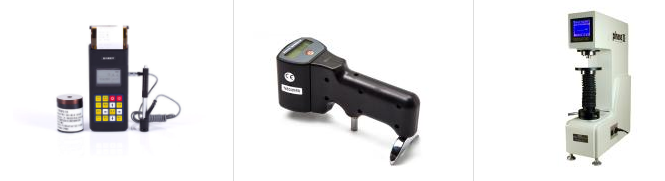
Brinell hardness is calculated using the following formula:
Brinell hardness HB = test force applied in kilogram force (kgf) ÷ indentation surface area (mm2)
This hardness test method has the widest and deepest indentation among the 5 test methods mentioned in this article, allowing the test to be performed on a larger specimen surface area. This provides a test average of hardness over a wide material surface area, which has the advantage of taking into account metal surface and grain irregularities. However, Brinell hardness testing is slower than other testing methods and leaves a large, long-lasting impression on the test sample.
Rockwell hardness test
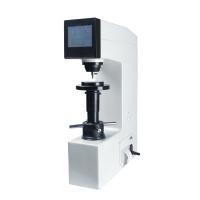
The Rockwell hardness test evaluates the permanent hardness of a material by measuring the depth of indentation due to the applied concentrated load. The higher the number on the Rockwell hardness scale, the harder the material. The test is carried out by applying a small force of 10 Kg on the surface of the material using a diamond cone or a steel ball indenter. Record the indentation depth from this initial load and use this as a reference point.
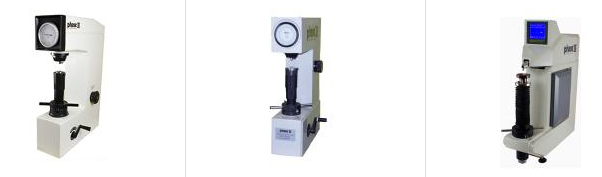
The specified principal load is then applied for the specified dwell time, thereby further indenting the test sample. The difference between the datum position and the indentation depth due to the principal load is calculated and recorded as the permanent indentation depth.
Rockwell hardness is calculated using the following formula:
Rockwell hardness, HRC = [0.2 – permanent indentation depth (mm)] x 500
The Rockwell hardness test was developed to have a lower destructive force and price than the Brinell hardness test. Measuring hardness at different depths helps eliminate errors due to surface imperfections. Moreover, the hardness value can be read without additional optical equipment, which makes it one of the common hardness testing methods.
Vickers hardness test
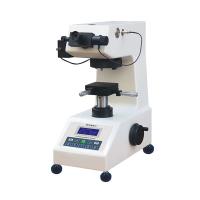
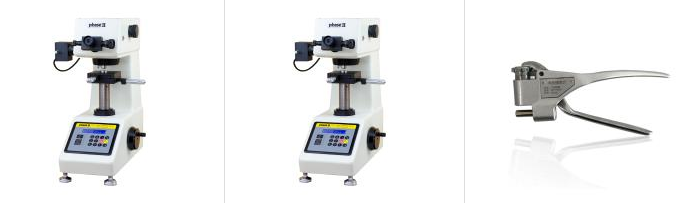
The Vickers hardness test involves the use of a 4-sided square-based cone indenter with a precisely defined constant force on the specimen to evaluate the surface area of the indentation. First lift the sample until it makes contact with the indenter. Then, the test force is applied to the test sample by the indenter and slowly increased until it reaches its specified value. This force is then maintained for the appropriate dwell time and the surface area of the diamond or square indentation is calculated.
Then use the following formula to find the Vickers hardness of the material:
Vickers hardness, HV = test force applied in kilograms force (kgf) ÷ indentation surface area (mm2) or HK = 1.854 x (F/D2)
By using a diamond-shaped indenter as opposed to a spherical shape (such as in Brinell hardness testing and Rockwell hardness testing), Vickers hardness testing can be done with less force and greater accuracy can be achieved. By magnifying the surface of the test metal, the test can be used to target microstructural constituents such as martensite or bainite. Because Vickers hardness testing requires the use of optics and measurement equipment as well as material preparation, it tends to cost more and take longer than Rockwell testing than other hardness tests.
Knoop hardness test
Knoop hardness testing is very similar to Vickers hardness testing in that a diamond/pyramidal indenter is applied to the test material for a specific dwell time. However, the Knoop indenter is an elongated diamond shape so that brittle materials and thin layers can be tested without fracture.
The main diagonal of the Knoop indenter is approximately three times longer than the Vickers diagonal and penetrates the material at half the Vickers test depth, making it more suitable for testing brittle materials such as ceramics.
The Knoop hardness test produces diamond-shaped indentations where one diagonal is seven times as long as the other.
Knoop hardness is calculated by the following formula:
Knoop Hardness, HK = Applied test force in kilogram-force (kgf) ÷ indentation surface area (mm2) or HK = 14.229 x (F/D2)
Mohs hardness test
The Mohs hardness test, unlike the previously mentioned tests, does not involve the application of force via an indenter. This test measures the relative hardness of a material by defining how resistant it is to being scratched by other substances. Developed by German geologist and mineralogist Friedrich Mohs, the hardness of a material is determined by observing whether its surface can be scratched by another material of known hardness.
This property is assigned a numerical value by ranking the minerals along a hardness scale (Mohs scale) consisting of 10 minerals. The higher the number on the scale, the harder the mineral. For example, if a substance of unknown hardness is scraped by rough stone enzymes but not by apatite, it has a Mohs hardness of between 5 and 6.
The hardness increments on the Mohs hardness scale are very arbitrary and not linear or proportional. For this reason, the test is primarily used to determine the relative hardness of minerals and not other materials such as metals.