Every material has a purpose, and every purpose has certain properties required of its material. The phone case is designed to prevent the phone from breaking when it is dropped, requiring the phone case to be impact resistant. The material used for a laptop case needs to be hard enough to protect the electronic components and be resistant to scratches, otherwise it will instantly look old and open to abuse. As consumers, we have high expectations for the products we buy, and as time goes by and technology improves, our expectations grow. This is especially important for manufacturers to test their materials to ensure they meet the specifications of the products being manufactured. But which test to use? Here, we will review some commonly used materials testing methods.
impact test
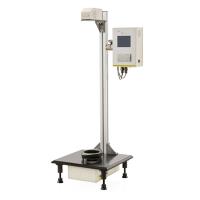
Regarding the durability of a material, two important properties are hardness and impact resistance. These may sound like the same thing, but they actually have different properties under different test methods. Diamonds are one of the hardest materials known to man. It resists being cut or scratched and is capable of cutting most other materials. Drill bits usually have diamonds in them that can cut through very hard materials that can bend metal. However, it is as hard as a diamond and very brittle. Scratch a diamond along a brick wall and it won't scratch, but smash it against the same wall and it will shatter. This is because although diamonds are very hard, they have low impact resistance. Impact Testers (or just "shock Testers") work by dropping a weight from various heights directly onto the material to be tested. The "amount" of impact is measured in inch-pounds, which is a unit of energy and can be calculated simply by multiplying the weight of the object being dropped by the height it will fall. Impact testing is a destructive measurement because to see where a material's breaking point is, it needs to be broken. When testing for impact resistance, it takes multiple tests with different amounts of foot-pounds to see where the breaking point is. This method is also used on coated surfaces to see how the coating will perform after being impacted. Will the coating crumble or peel from the substrate after impact? Has the color or appearance of the coating changed? Does the coating help improve the impact resistance of the material? These can all be determined using a shock Tester. Click here to view impact Testers.

Hardness Testing
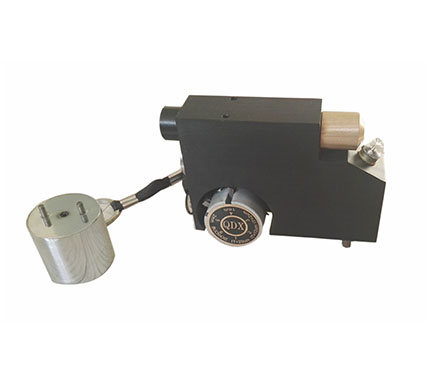
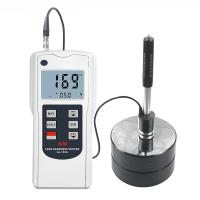
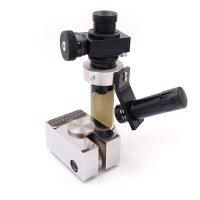
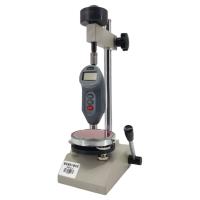
Hardness testing is less straightforward, which is why a variety of methods are used to test the hardness of a material. Most of these tests are destructive, but a pendulum Hardness Tester is a popular non-destructive test. This is done by suspending the pendulum from the test surface and starting the pendulum to swing. The top of the pendulum is a circular piece of metal that rests on the material to be tested, under which the pendulum swings. When the pendulum swings, the circular piece rotates slightly relative to the surface of the material. A stiff material will have little resistance (friction) to the disc, and the pendulum will swing for a long time. As the parts rotate, the softer material causes friction, which slows or "damps down" the motion of the pendulum. The pendulum is released from a specified height and the number of oscillations is counted until the pendulum is damped to a certain degree. The higher the number of oscillations, the harder the material.

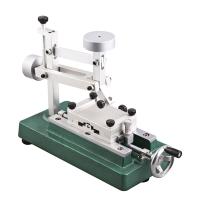
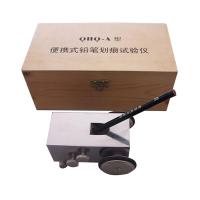
For destructive hardness testing, there are two popular methods: the pencil Hardness Tester, and the DUR-O-test. Pencil hardness testing is done using pencils with "leads" (actually graphite) of varying hardness. Pencils are graded from softest to hardest. To perform this test, a pencil is selected, the tip is sharpened, and it is dragged over the surface of the material being tested. If the pencil scratches the surface, repeat the test with a pencil with a softer lead. If the pencil doesn't scratch, use a harder lead. The idea is to identify the softest pencil that will scratch the surface. A device called the "Wolf-Wilburn Pencil Hardness Tester" was devised to hold the pencil at a specified angle and apply constant pressure as the lead moved across the surface of the material. This improves the accuracy and repeatability of the test compared to performing the test by hand. The DUR-O test is similar to the pencil hardness test, but the principle is slightly different. The pencil hardness test varies the hardness of the pencil lead but keeps the force between the pencil and the surface of the material constant, while the dur-o test uses a single tip but varies the force between the tip and the surface. The DUR-O test consists of a tube with a spring and a metal tip. The spring applies force to the tip and can be compressed various amounts to vary the force applied. For testing, the spring is compressed to provide the specified force, and the tip is pressed and dragged across the surface. If the tip scratches, reduce the spring force by reducing the compression force on the spring and repeat the test. If there is no scrape, increase the spring force by compressing the spring further and repeat the test. The idea is to find a spring force where the tip barely scratches. The springs in the device can also be varied to provide different force ranges.

Wide range of uses. They can be used to formulate new products to determine if formulation changes are required to meet certain specifications. They can be used for batch control to ensure materials are manufactured to required specifications. Scientists can even use them to test the performance of newly invented materials. In this age of ever-changing technology and consumers expecting products to look better, feel better and last longer, material testing has never been more important.