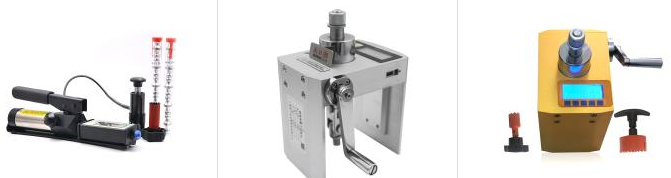
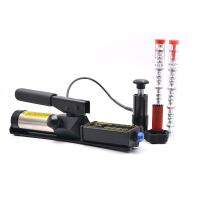
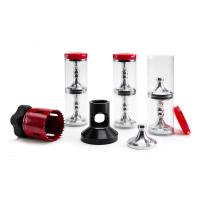
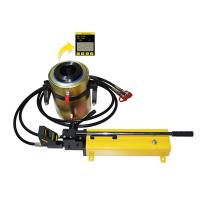
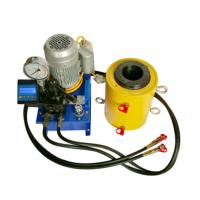
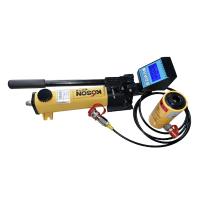
Pull-off adhesion testing according to ASTM D-4541 is a common quality control check for coatings on large diameter steel pipe. During the test, a metal trolley was glued to the pipe coating and then pulled off to evaluate the coating adhesion. In practice, the results are very sensitive to the environment, with large standard deviations compared to the mean. From a simple inspection of the Griffith equation for material strength, it is evident that the pull-out stress at fracture increases with the material's stiffness and interfacial failure energy, and decreases due to the presence of cracks or defects.
The finite element stress analysis explores the effects of coating and adhesive stiffness as well as some other possible causes of variation in results, for example, tube curvature, cart misalignment, and the effect of coating and glue scoring through the perimeter of the cart. The tensile modulus of three polyurethane coatings, an epoxy adhesive and a cyanoacrylate adhesive, were measured and the results indicated that the polyurethane coating may be harder than the adhesive used to secure the dolly. The location of maximum strain in the glue or coating is used as an indicator of where bond failure is likely to occur throughout the joint.
The results show that the influence of the misalignment of the trolley on the coated pipe is greater than that of the pipe curvature itself. If the cart is well aligned, the large strain and likely location of failure is at the top of the pipe at the pipe coating interface. The value of the strain is not a strong function of the curvature of the underlying pipe surface. If the cart is misaligned, the point of failure shifts to where the glue is thinnest, but if the glue is harder than the paint, it remains at the paint-pipe interface. However, if the coating is stiffer than the glue, the locations of the two maximum strains indicate that, in all cases, failure is more likely to occur at the glue-dolly junction than at the coating-tube interface. Users should be aware of how these and other possible variations can affect pull results if they rely on single-vehicle pull values to assess overall adhesion or use test methods to assess the likely reliability of coated steel pipe in service. If the glue is harder than the glue, the failure site is shifted to where the glue is thinnest, but remains between the hose and the pipe. However, if the coating is stiffer than the glue, the locations of the two maximum strains indicate that, in all cases, failure is more likely to occur at the glue-dolly junction than at the coating-tube interface. Users should be aware of how these and other possible variations can affect pull results if they rely on single-vehicle pull values to assess overall adhesion or use test methods to assess the likely reliability of coated steel pipe in service. If the glue is harder than the glue, the failure site is shifted to where the glue is thinnest, but remains between the hose and the pipe. However, if the coating is stiffer than the glue, the locations of the two maximum strains indicate that, in all cases, failure is more likely to occur at the glue-dolly junction than at the coating-tube interface. Users should be aware of how these and other possible variations can affect pull results if they rely on single-vehicle pull values to assess overall adhesion or use test methods to assess the likely reliability of coated steel pipe in service. The locations of the two maximum strains then indicate that failure is more likely to occur at the glue-dolly junction than at the coating-pipe interface in all cases. Users should be aware of how these and other possible variations can affect pull results if they rely on single-vehicle pull values to assess overall adhesion or use test methods to assess the likely reliability of coated steel pipe in service. The locations of the two maximum strains then indicate that failure is more likely to occur at the glue-dolly junction than at the coating-pipe interface in all cases. Users should be aware of how these, and possibly other variations, affect pull if they rely on a single bike's pull values to assess overall adhesion or use test methods to assess the likely reliability of coated steel pipe in service