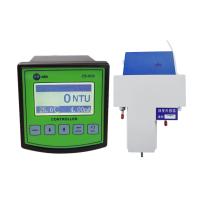
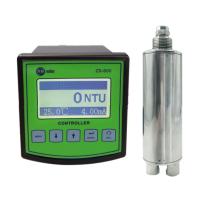
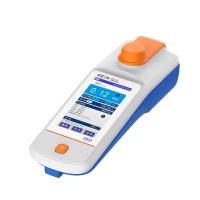
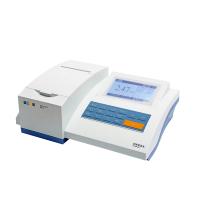
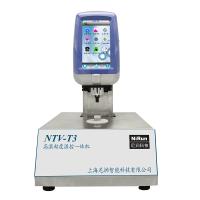
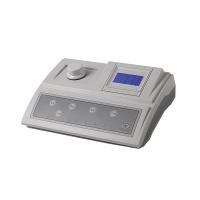
Nephelometric and turbidimetric methods are used for continuous monitoring of air and water pollution. In water, turbidity is monitored, while in air, soot is monitored. The technique is also used in food, beverages and to determine the molecular weight of polymers that settle on the ground from factories. CO2 can also be determined by this technique.
Turbidity analysis is based on measuring the intensity of light flux scattered by solid particles suspended in solution.
Nephelometric analysis (nephelometric method) is based on measuring the decrease in luminous flux intensity at h. through a solution containing suspended particles. The intensity is reduced due to the absorption and scattering of light.

Principles and theory of turbidimetry and turbidimetry:
The principles of nephelometry and turbidimetry are based on the scattering or absorption of light by solid or colloidal particles suspended in a solution. When light passes through a suspension, a portion of the incident radiant energy is dissipated through absorption, reflection, and reaction, while the remainder is transmitted.
In fact, the measurement of transmitted light intensity as a function of the concentration of the dispersed phase becomes the basis for turbidimetric analysis.
As shown below:

Turbidimetry is somewhat different from turbidimetry. In nephelometry, light passes directly through the sample solution (suspended particles) and the amount of scattered radiation is measured, usually at 90°C (Figure 6). The measurement of the intensity of scattered light as a function of the concentration of the dispersed phase is the basis of turbidity analysis.

It is important to note that in nephelometry the incident and scattered light have the same wavelength, whereas in fluorometry (fluorescence) the scattered light has a longer wavelength than the incident light.
theory:
For turbidity measurements, the transmitted intensity I can be determined from the formula.
I 0 = incident intensity.
I t = transmitted intensity.
C = concentration of absorbing particles in solution
1 = Thickness of solution absorbing layer.
This equation (1) is known as the basic equation of turbidimetry and is similar to the Bouguer – Lambert – Beer equation:
I t = I 0 ×10 –k'lc
where k' is the molar turbidity coefficient of the solution.
Operating conditions for turbidimetry and turbidimetry:
In turbidity and turbidity analysis, there are many conditions that need to be met to work successfully.
Since the amount of light scattered or absorbed depends on the size of the particles in solution, correct results will depend on the method of preparing the suspension and the reproducibility of its optical properties.
The following factors affect the optical properties and particle size of the suspension:
(a) The concentration ratio of the mixed solution,
(b) the order in which the solutions are mixed,
(c) the concentration of ions forming the precipitate,
(d) temperature
(e) mixing speed,
(f) excess electrolyte is present,
(g) the stability of the dispersion,
(h) the presence of non-electrolytes,
(i) the presence of a protective colloid, and
(j) Time required to reach maximum turbidity.
Instrument nephelometric and turbidimetric methods:
The instruments used in nephelometry and turbidimetry are similar to those used in spectrophotometry.
我们将在这里描述一些特殊功能:
(1)资料来源:
浊度计和浊度计均使用单色辐射。通常,汞弧或带有特殊过滤器组合以隔离其发射线之一的激光器是较合适的光源。
当需要确定特定物质的浓度时,使用钨灯(多色光源)。已经观察到,即使在这种情况下,蓝色光谱区域也能提供很好的结果。
(2)单元格:
通常,选择具有矩形横截面的单元进行研究。我们还可以使用具有平面的圆柱单元,其中入射光束和现有光束会通过这些平面。八边形面允许在135°C,90°45°或0°的条件下对主光束进行测量。光束不通过的壁被涂成黑色,以吸收有害的辐射。
(3)探测器:
在浊度计中,光电管用作检测器。
由于散射辐射的强度通常很小,因此在浊度计的情况下,光电倍增管用作检测器。通常,探测器与主探测器的角度固定为90°,但为获得最大灵敏度,探测器角度应有所变化。在某些浊度计中,检测器安装在圆盘上,该圆盘允许以多个角度(即0°和35°至135°)进行测量。
比浊法和比浊法的实验技术:
电灯发出的强光穿过过滤器,该过滤器仅在要使用仪器进行发光研究的地方放置,并落在玻璃板上。光束的一部分从该板反射并落在玻璃衰减器上,而一部分进入充满正在研究的溶液的细胞。
现在,穿过细胞的光束在光阱中熄灭。溶液中的粒子反射的光束的一部分穿过透镜,可调光阑,透镜,并由菱形棱镜引导通过滤镜进入目镜,在该目镜中仅照亮一半的光场。
来自衰减器的光通量穿过透镜,可调光阑,透镜,菱形棱镜,滤光片,经过类似的路径,然后进入目镜以照亮后半场的光。现在,通过改变可调节膜片的缝隙宽度,可以使光通量相等,即达到光学平衡。
在使用此研究中的仪器解决方案时,应将可调节膜片的刻度盘设置为零,并通过安装可互换的衰减器来使光通量强度接近。然后,通过可调节的光阑来平衡光通量。
对一系列包含确定数量的被分析物质的溶液进行此类测量,然后绘制校准曲线,将可调节膜片读数与溶液浓度相关联。此后,可以使用此校准曲线从隔膜读数中确定未知浓度。
计算方式:
金属或离子的浓度可由下式确定:
c ^ 1 = C 0 1 1 /1 2
where C1 and C2 are the concentrations of the standard solution and the unknown solution, respectively.
1 1 and 1 2 are the layer thicknesses in the turbidimeter cell.
Nephelometric and Nephelometer Applications:
Nephelometric and nephelometric methods can be used in gaseous liquids and even transparent solid samples.
Applications of these techniques, or both, are summarized below:
(1) Air and water pollution:
Nephelometric and nephelometric methods are used in the study of air and water pollution. In air, dust and smoke are measured, while in water, turbidity is measured.
(2) Inorganic analysis:
The main use of nephelometry and turbidimetry is to determine sulfate as BaSO4, chloride as AgCl, fluoride as CaF2, cyanide as AgCn, calcium oxalate as oxalate, carbonate as BaCO3 and zinc as Ferrocyanide.