The correct coating chemistry can provide long-lasting durability to fabrics that will fade, degrade and fail before their expected useful life. This is especially true for fabrics used in awnings, tents, flexible decks, outdoor furniture, marine upholstery, and automotive seating, where exposure to harsh environments can accelerate product lifecycles.
Many complex parameters surround the engineering process of a new paint formulation. Coating success depends on testing and evaluating the integrity and performance of the formulation on each substrate for individual use.
Coating engineers rely on a number of industry standard tests that allow customers to certify products to meet end user performance needs. These tests are conducted in a controlled laboratory environment designed to be more rigorous and rigorous than real-world environments and are a good indicator of performance and lifetime.
Every member of the supply chain is involved in ensuring the success of the product in the field. This includes material manufacturers, paint applicators and fabricators. An understanding of the testing process and how to use these tests to evaluate coatings for specific applications and materials is required.
Adhesion
Whether using flexible vinyl or woven fabrics, achieving adhesion is a must for successful coating chemistry. ASTM D751-06 covers adhesion testing to coated fabrics such as tarpaulins and raincoats. It evaluates:
Breaking strength
elongation
Bursting Strength
Puncture resistance
tear strength
Hydrostatic pressure
strength
tear resistance
Low temperature bending, impact and cracking
Seam strength (including static load seam strength)
accelerated heat aging
Blocking resistance at high temperature
Compressive strength
Coated Cloth Wicking
ISO 2409 is a good qualitative test method for evaluating a coating's resistance to separation from the substrate when a rectangular lattice pattern is cut into the coating and penetrates the surface of the material. The method can be used either as a passing test or, where appropriate, as a six-step classification test that can be performed in the laboratory or on field samples.

wear and tear
Coatings on substrates can be damaged by abrasion during manufacturing and repair. For woven materials, abrasion resistance is affected by factors such as the inherent mechanical properties of the fibers; the size of the fibers; the structure of the yarn; the structure of the fabric; and the type, variety and amount of trim material added to each component.
Whereas "abrasion resistance" (usually expressed in terms of the number of cycles on a specified machine, using a specified technology to produce some degree or amount of wear) and "durability" (defined as the ability to withstand degradation or wear in use) (including impacts) are often correlated and this relationship varies depending on the end use of the material or the environment to which it is exposed.
ASTM D4157 Standard Test Method for Abrasion Resistance of Textile Fabrics (Vibrating Cylinder Method, also known as the Wyzenbeek Method) is a widely used test for textile textiles such as furniture fabrics and clothing. Pull a sample-sized piece of fabric taut into the frame and rub the material using a Wyzenbeek machine using #10 cotton duck fabric as an abrasive or wire mesh. The test is complete when two broken ends occur, significant wear is determined, or 100,000 double rubs are achieved.
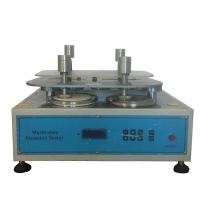
Another abrasion test is the ASTM D4966-98 Standard Test Method for Abrasion Resistance of Textiles (also known as the Martindale Abrasion Tester Method). It can be used on soft vinyl as well as woven fabrics such as contract seating, soft roofing membranes, car seating, marine trim, wall coverings and rolls. The coating was applied to the substrate, and the samples were then mounted on a Martindale abrasion Tester. The material is then rubbed in a figure-eight motion until failure or the number of rubs specified by the manufacturer, and the substrate is evaluated.

accelerated photoaging
Sunlight, moisture and heat can cause changes in the physical properties of the coated material, resulting in overall loss of performance, fading, and adverse changes in the flexibility of the material. Accelerated photoaging (sometimes called QUV testing or accelerated weathering) is a key test for products intended for outdoor use.
In the coatings industry, ASTM G155 Standard Specification for Xenon-Arc Lighting Apparatus for Operating Non-Metallic Materials is a common test method for understanding the effects of photoaging during development. Typically, testing exposes a similar material (control) of known properties to a test sample for comparison. In this test, a xenon arc lamp and water fixture are used to reproduce the weathering effects that occur when materials are exposed to sunlight, directly or through window glass, as well as moisture, such as rain or dew.
The American Association of Textile Chemists and Colorists (AATCC) has a similar test method, TM16.3, for testing colorfastness to light using a xenon arc light source. Another related standard, ASTM D 4329, deals with UV exposure of plastics (including polymer coatings) under fluorescent lighting. Specify the appropriate accelerated photoaging test based on the material application or customer preference.

stain resistant
Since the paint will smudge, it will be less hydrophobic. Chemicals can be custom formulated to help combat this by pulling water into the fabric to remove the stain, and then pushing the water out of the substrate.
AATCC™ 8 can be used for color fastness testing. This method is designed to determine the amount of color transferred from a surface of a colored textile material to another surface by friction. The colored samples were wiped ten times with wet and dry white tub test cloths. A grade is assigned by comparing the color it transfers to a white test cloth with the gray scale or shade transfer scale used for dyeing.
The automotive industry has a specific test for evaluating the adhesion and stain resistance of paints on furniture or seats. The industry follows ASTM D4966-98 (or the Martindale Abrasion Test) and combines unwashed denim with decorative substrates. Each manufacturer has variations on this test and interprets the acceptable level of blue dye transfer differently.
Stain resistance is often related to chemical resistance. Another important test for stain resistance is covered by the ASTM D1308 standard test method for the effect of commodity chemicals on clear and pigmented organic surface treatments. This test evaluates criteria such as discoloration, change in gloss, blistering, softening, swelling, loss of adhesion or special phenomena. It is performed by introducing droplets of contaminants onto the substrate at time intervals specified by the customer or chemist. Droplets can be covered with a watch glass for more rigorous testing, or left uncovered. Then wipe it clean and check the area immediately for results.
AATCC TM 130 Soil Release: Oily Stain Release Method is designed to measure the ability of a material to release oily stains during laundering. It is primarily used by fabric finishes to assess the likely performance of a stain release finish in actual use. In the test, a stain (corn oil or other stain of customer choice) is applied to the test specimen. Press the amount of staining material into the fabric using the specified weight. The test fabrics were then washed and the residual stains were rated 5:1 by comparison to a control sample showing a range of stain ratings.
waterproof
There are many ways to test the water repellency of coated fabrics. Determining the appropriate test depends entirely on the end use of the material. A widely used method, AATCC TM 22 Water Repellency: Spray Test, is applicable to any textile and is especially useful for measuring the water resistance of finishes applied to fabrics. Spraying water on the surface of the taut sample creates a pattern of wetting, the size of which depends on the relative repellency of the fabric. Then compare the wetted pattern to the picture on the standard chart.