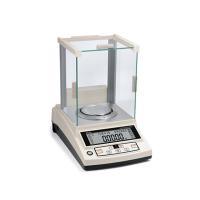
The history of balances can be traced back to ancient Egypt. A simple equilibration on a fulcrum comparing the two masses is the standard. Today, scales are more complex and serve multiple purposes. Applications range from weighing chemicals in the laboratory to weighing transport packages.
To fully understand how the types of balances and scales work, one needs to understand the difference between mass and weight.
What is quality?
Mass is a constant unit of the amount of matter an object possesses. It remains the same no matter where the measurement is taken. Common units of mass are kilograms and grams.
What is weight?
Weight is the weight of an item. It depends on the gravity on the item multiplied by the mass (constant). Due to the changing gravity, an object on top of a hill will weigh less than the same object on top of a hill. The unit of measurement for weight is the Newton. Newton took into account the mass and relative gravity of an object and gave the total force, or weight.
Even though mass and weight are two different entities, the process of determining mass and weight is called weighing.
Balance and Scale Clause
The ability of a precision scale to provide results as close as possible to the actual value. When comparing masses of a kilogram, a good modern balance is accurate to better than one part in 100,000,000.
Calibration The comparison between the output of a scale or balance and a standard value. This is usually done with known standard weights and adjusted so that the instrument gives consistent readings.
Capacity The maximum load that can be measured on an instrument.
The amount of agreement between repeated measurements of the same amount of precision; also called repeatability. Note: Scale bars can be very precise, but they don't have to be.
Readability This is the smallest marking on a scale or balance that can be read. It can vary from 0.1g to 0.0000001g. Readability indicates how many digits after the decimal point the scale can be read.
Tare The act of removing an object of known weight, usually a weighing container, to zero the scale. This means the final reading will be of the material being weighed and will not reflect the weight of the container. Most balances allow tare up to 100% of capacity.
Types of Balances and Scales
Analytical Balances
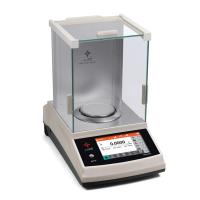
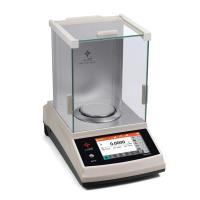
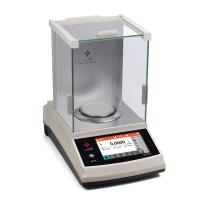
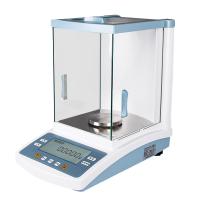
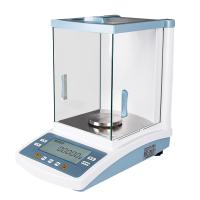
These are often found in laboratories or where extremely high sensitivity is required to weigh items. Analytical balances measure mass. Chemical analysis is always based on mass, so results are not based on gravity at a specific location, which affects weight. Typically, analytical balances range in capacity from 1 g to several kilograms, with precision and accuracy often exceeding 106 parts of full scale. An analytical balance has several important parts. The beam blocker is a mechanism that prevents damage to the delicate internals when placing or removing objects from the pot. The weighing pan is the area of the balance where objects are placed for weighing. The leveling feet are adjustable feet that allow the balance to be adjusted to a reference position. The reference position is determined by a spirit level, leveling balance or plumb bob, which is an integral part of the balance. Analytical balances are so sensitive that air currents can affect measurements. To prevent this, they need to be covered with a windshield. This is a plastic or glass enclosure with a door to allow access to the pot.
Equal Arm Balance/Stroke Balance
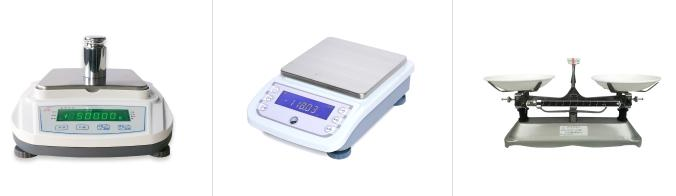
This is a modern version of the ancient Egyptian scale. This type of laboratory scale has two pots on opposite sides of a lever. It can be used in two different ways. The object to be weighed can be placed on one side and standard weights are added to the other pan until the pan is balanced. The sum of the standard weights equals the mass of the object. Another application of this scale is to place two items on each scale and adjust one side until both pots are leveled. This is handy in applications like balancing tubes or centrifuges, where two objects need to have exactly the same weight.
platform scale
This type of scale uses a multiplying rod system. It allows heavy objects to be placed on the load-bearing platform. The weight is then transferred to a beam that can be balanced by moving a counterweight, an integral part of the scale that balances the weight on the platform. This form of scale is useful for things like weighing buckets and even weighing animals in veterinary offices.
spring balance
This balance utilizes Hooke's law, which states that stress in a spring is proportional to strain. A spring scale consists of a highly elastic coil of hard spring steel suspended from a fixed point. The weighing pan is mounted at the lowest point of the spring. The indicator shows the weight measurement, eliminating the need to manually adjust the weight. An example of this type of balance is the scales used in grocery stores to weigh produce.
top load balance
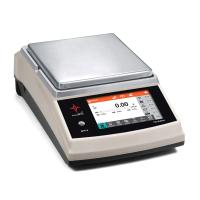
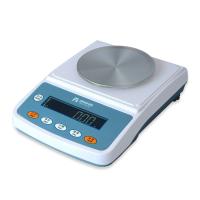
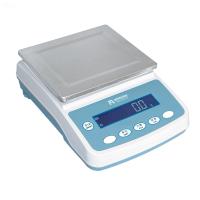
This is another type of balance that is primarily used in laboratory settings. They can usually measure objects weighing around 150–5000 g. They are less readable than analytical balances, but allow quick measurements, making them a more convenient choice when precise measurements are not required. Top loaders are also more economical than analytical balances. Modern top load balances are motorized and provide digital readouts in seconds.
twisting the balance
Measures twist based on wire or fiber. Many microbalances and ultramicrobalances weigh fractions of grams and are torque balances. A common fiber type is quartz crystal.
Triple-beam balances This type of laboratory balance is less sensitive than a top-loading balance. They are often used in classrooms due to ease of use, durability, and cost. They are called triple-beam balances because they feature thirty-plus-year weights that slide along individually calibrated scales. These three decades are usually divided into 100g, 10g and 1g. These scales are much less readable, but good enough for many weighing applications.
Balance maintenance and use
Like other measuring equipment, balances have special procedures for use and care. The item under test should be weighed at room temperature. As convective currents cause hot items to float, the reading will be less than the actual weight. And if your balance is closed, the warm air in the box weighs less than the same volume of air at room temperature.
Another important part of using a balance is cleaning. Lab scales are exposed to many chemicals that can react with the metal in the pan and corrode the surface. This will affect the accuracy of the scale.
Also, keep in mind that potentially dangerous situations can occur if dust is left on a laboratory balance. In many laboratory and classroom settings, more than one person weighs on a single scale. It is impossible for everyone to know what everyone else has been measuring. If left standing, incompatible chemicals could be exposed, or someone could be exposed to hazardous chemicals that were not cleaned from the balance. To avoid damaging the balance or putting others at risk, it should be kept very clean. The camel's hairbrush can be used to remove dust that may spill during the weighing process.
Calibration is another concern when it comes to scales. Scales cannot be infinitely precise; they need to be rechecked for accuracy. There are weight sets available that allow the user to calibrate the scale themselves, or the scale can be calibrated by hiring a professional to calibrate the scale on site.
When calibrating a scale, it is necessary to select the correct set of weights. The classes of weight sets start with class 1 which provides the highest precision, then go to classes 2, 3, 4 and F, and finally drop down to class M, which is the weight for average precision. The weight set has a class tolerance factor, usually, the tolerance factor should be larger than the readability of the scale.
Class 1 has very high precision and can be used to calibrate high precision analytical balances.
Level 2 is used to calibrate high precision top load balances. The rest of the classes use weighted down weights. In fact, the calibration weight itself often needs to be recertified to the required accuracy of the weighing instrument. Numerous government and industry regulations require proof of accuracy. Weight can change due to scratches, wear, accumulated dust and atmospheric corrosion, reducing the accuracy of the kit.