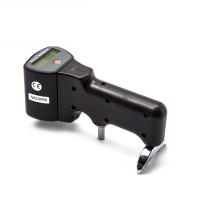
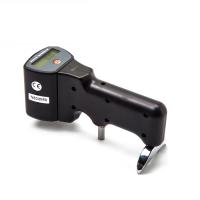
Instrument switch
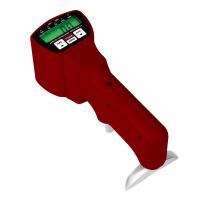
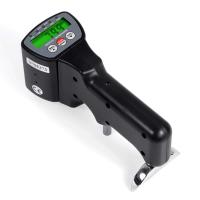
Press and hold the switch key on the instrument head to start the machine, and when the screen displays "OPE", it means that the self-test of the instrument is completed, and it can enter normal use. The instrument will automatically shut down after 5 minutes of inactivity; or press and hold the switch key on the instrument until the screen displays OFF, then release it to turn off the power of the instrument.
Measurement methods
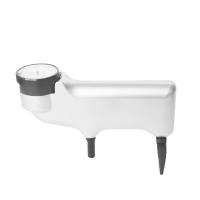
After the instrument is turned on, hold the instrument in hand, contact the instrument indenter and the bracket vertically on the surface of the sample, and apply sufficient contact pressure downwards steadily and quickly, the instrument indenter needle is pressed into the surface of the sample, and the value displayed on the instrument screen is the material Barcol hardness value. Release the switch, and the display will retain the current detection value.
The default hardness unit of this instrument is Barcol, and the corresponding Webster, Rockwell, Vickers, and Brinell hardness values can be obtained through the unit conversion button. You can also pre-set one of the hardness units of Webster, Rockwell, Vickers, and Brinell through the hardness value display conversion button. When the indenter is in the indentation state, the instrument screen displays the default Barcol hardness value, and the indenter needle is lifted . The screen will display the hardness value under the preset hardness system.
Charging instructions
When the instrument is in use, if "BAT" flashes on the screen, it means that the battery voltage is exhausted and the instrument needs to be charged. When charging, insert the round plug of the special charger attached to the instrument into the charging socket on the meter head of the instrument, and plug the charger into the 220V power supply. At this time, the indicator light of the charger shows red to indicate that it is charging. When the light turns green, it means charging is complete.
Note: Only use the original charger when charging, otherwise the instrument will be damaged or even cause the battery to explode.
Factors Affecting Measurement Accuracy
Sample: The surface of the sample should be cleaned, the dirt on the sample, especially the fine sand will affect the measurement accuracy;
Sensitivity: If the hardness value of the workpiece to be tested is not outside the measurement range of the instrument (25HBW~135HBW), the measurement sensitivity of the instrument will decrease and the measurement accuracy will not be high. At this time, other Hardness Testers should be considered;
Sample edge: The distance from the measuring point to the edge of the sample should be greater than 3mm during the test, and being close to the edge of the sample will affect the measurement accuracy;
Adjacent indentations: When testing, it should be noted that the distance between two adjacent indentations should be greater than 3mm, otherwise the previous indentation will affect the accuracy of the next measurement ;
Oxide film: Even if the hard oxide film is very thin, it will affect the accuracy of the measured value;
Coating: Various coatings on the surface of the instrument will seriously affect the measurement accuracy. Therefore, the hardness measurement should be performed after removing the coating with sandpaper or solvent before measurement .
Precautions for use
When measuring, the surface of the sample should be in vertical contact with the indenter, otherwise measurement errors will occur;
During the test process, the body of the instrument should be kept stable without shaking, otherwise the indenter may be damaged;
The surface of the sample should be smooth, clean and free from mechanical damage. If necessary, the surface of the sample can be lightly polished to remove scratches or coatings;
The thickness of the sample should not be less than 1.5mm, and there should be no obvious deformation marks on the supporting surface of the sample after the test;
The size of the sample should ensure that the minimum distance from the tip of the indenter to any edge is not less than 3mm;
It should be ensured that there is no old indentation left by the previous test within 3mm around the indenter at the current test point;
The sample should be placed stably, and the small sample should be placed on a hard and stable pad (such as steel plate, glass plate, etc.). The sample should not be lifted, and the sample should not have any movement or elastic deformation during the test ;
This instrument uses the method of obtaining the average value through multiple tests to measure the hardness value of the material. The softer the sample material, the more tests should be performed. For composite materials, the number of tests should be more;
Please refer to the paper manual for the recommended measurement times corresponding to different hardness values on homogeneous materials and heterogeneous materials.