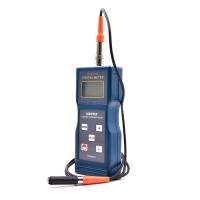
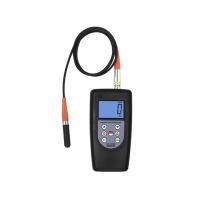
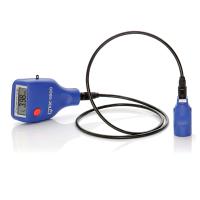
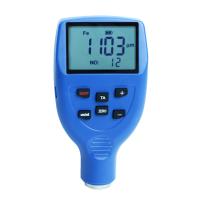
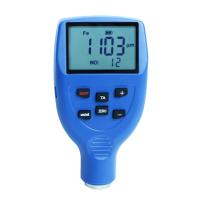
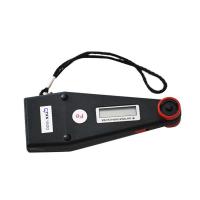
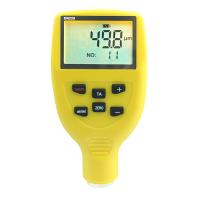
Anti-corrosion coatings or double coatings consisting of paint or plastic coatings applied to galvanized steel sheets are often used in manufacturing. As with any corrosion protection system, the thickness of the individual coats is an important quality factor for double-sided coatings
Operators can determine individual coating thicknesses for double-sided coating systems.
Anti-corrosion coatings or double coatings consisting of paint or plastic coatings applied to galvanized steel sheets are often used in manufacturing.
As with any corrosion protection system, the thickness of the individual coats is an important quality factor in double-sided coatings. Thickness measurements should be non-destructive for obvious reasons, not least because of the costs involved. The newly developed measurement method for this type of application is suitable for several practical application examples.
There are several types of double-sided coatings, classified according to their measurability:
Hot-dip galvanized steel parts with a zinc coating thickness greater than 80 microns have a unique zinc-iron diffusion zone, while paint coatings are typically greater than 85 microns. These are mainly found in the field of steel construction.
Versions with zinc thickness between 0 and 10 microns, deposited by electroplating or dipping bath, with paint thickness up to 150 microns. They are mainly found in body building.
Coating systems on pipes, such as brake lines, sheet metal on building exteriors, items such as shopping carts or household appliances, have a zinc thickness of up to about 30 microns, and organic coatings of paint or plastics are typically less than 200 microns thick.
A coating consisting of an organic layer and a zinc-iron or zinc-nickel alloy layer. Due to the higher cost of zinc alloy coatings, they are mainly found in the automotive industry on components with a high risk of corrosion.
If the zinc coating is uniform in thickness, the thickness of subsequently applied paint coatings can be measured using a conventional magnetic induction coating Thickness Gauge.
Select measurement method
Since these duplex systems are a combination of organic and metallic coatings, typical measurement methods for determining multilayer coating systems are excluded because they cannot measure purely organic coatings. Thus, an economical non-destructive and user-friendly instrument combines magnetic induction and eddy current testing methods.
Using the magnetic induction method according to the new ASTM Practice D 7091 or DIN EN ISO 2178, it is possible to measure all coatings made from non-magnetic coatings applied to ferrous and ferrous metals. Non-magnetic, non-conductive coatings on non-ferrous metals can be measured using the conventional eddy current method according to ASTM Practice D 7091 and DIN EN ISO 2360.
For example, if an intermediate zinc coating can be considered the base material, it should be possible to measure paint coats on the intermediate zinc coating. Unfortunately, the conductivity of hot-dip galvanized or electro-deposited zinc coatings is only about 7 megasiemens per meter (MS/m), and copper is 58 MS/m. At a measuring frequency of around 20 megahertz (MHz), which can be achieved with reasonable expenditure, the zinc coating should be at least 80 to 100 microns thick if thickness fluctuations do not affect the measured values. paint thickness. Only duplex systems in the first group fall into this category.
In a modified version, the phase-sensitive eddy current method can be used to measure metallic coatings on essentially any substrate material.
One application is the measurement of non-ferrous coatings on ferromagnetic steel. With a suitable instrument design, such measurements can be performed even under non-conductive coatings.
The electrical signal originating from the probe can be thought of as a vector with variable amplitude and phase angle or phase. For a two-coat system, a change in zinc thickness results in a change in the magnitude and phase of the vector, whereas an increase or decrease in paint thickness really only affects magnitude.
By using suitable instrument electronics capable of evaluating the probe signal based on its magnitude and phase, the zinc thickness can be determined based on phase, independent of the paint thickness on top. The magnitude of the phase transition induced by the zinc thickness can be optimized by an appropriate choice of eddy current measurement frequency for the zinc thickness range in question.
Mathematically, since dual phase coatings are a system of equations with two unknowns, the solution requires two independent equations. The first is represented by the phase-sensitive eddy current method, while the second can be obtained only by the conventional magnetic induction method. As previously mentioned, this method can be used to measure the overall thickness of duplex systems. If the individually measured zinc thickness is subtracted from this measurement, the resulting value is the thickness of the organic coating.
A third unknown emerges from the equivalence between the measurements of the double layer coating and the magnetic properties different from the substrate or the pure zinc coating.
The eddy current method also requires a sufficiently high electrical conductivity of the metal coating, which should be measured in such a way that eddy currents can be generated.
Unfortunately, the described zinc coating exhibits a conductivity significantly less than 1 MS/m due to its crystalline structure. To be able to perform coating thickness measurements on the basis of phase measurements, frequencies in excess of 10 MHz are required - these are not achievable in typical coating thickness instruments.
Large components that are often encountered in practical measurements combine the magnetic induction method with the phase-sensitive eddy current method. After the probe is placed, measurements are taken sequentially using both methods without any additional action by the operator. Then measure the data appropriately. Therefore, the probe needs to contain the measurement systems required by both methods.
This coating Thickness Gauge measures paint thickness independent of zinc thickness. Zinc thickness measurement has a repeatable accuracy down to tens of nanometers, while paint thickness measurement has a repeatable accuracy of less than 0.5 microns.
Auto body coating thickness measurement
In the automotive industry, the use of galvanized steel sheets is increasing. Sheet metal suppliers can apply zinc coatings by galvanic deposition or in a zinc dipping bath. If the zinc coating is uniform in thickness, the thickness of subsequently applied paint coatings can be measured using a conventional magnetic induction coating Thickness Gauge. Just subtract a constant value from the actual reading.
This uniformity of zinc thickness is generally given within a batch of supplied sheet that still needs to be formed. When forming body parts, flow and even scratching of the zinc coating can occur in areas of severe bend radii and can vary in thickness from 3 to 9 microns, sometimes completely removing the coating.
A similar situation is encountered when repairing areas of a bodywork that have had coating defects due to sanding and subsequent repainting of the defective areas. Also in this case, if a conventional paint coating thickness measurement system is used, the zinc coating may also be sanded off, resulting in a significant reduction in paint thickness. This is problematic not only for the inspection of finished painted bodies, but also for the quality monitoring of electrophoretic paints. Since this thickness is usually only about 20 microns, the defect in the measurement of coating thickness is the thickness reduced by 5 or 6 microns. The importance of zinc coating cannot be overemphasized.
The use of aluminum in non-safety-related parts of the body is becoming more common in order to reduce the weight of vehicles. Therefore, this coating Thickness Gauge is also equipped with a conventional eddy current channel to measure the coating thickness on these parts according to the standard.
Sheet metal suppliers apply zinc coatings by galvanic deposition or in a zinc dipping bath.
The operator may not even know which parts are steel and which are aluminum, so no action is required on the part of the operator, the instrument will automatically select the desired measurement method as soon as the probe touches the substrate and is immediately stored - Dual phase or vortex. Paint thickness data from the same application, so that the paint thickness distribution can be easily evaluated independent of the sheet metal type.
Examples of applications using double coatings on pipes or wires can be found in brake and fuel lines in the automotive industry, as well as in other pipes subject to high corrosion loads or in the manufacture of shopping carts made of wire mesh. In most of these cases, the double coat consists of a relatively thick zinc coating of about 25 to 30 microns and a paint or plastic coating usually between 20 and 100 microns.
Here, it is also important to measure both coatings separately, since they have different tasks to fulfill and the quality depends on the individual thicknesses. Particularly advantageous is the measuring method for products in which both coatings are applied in a continuous production process, as is the case with brake or fuel lines.
In such applications, the plastic coating is applied to the coiled tubing immediately after electrogalvanizing. The intermediate inspection of the zinc coating represents a costly interruption of the production process.
The introduced measurement method provides a friendly and reliable nondestructive thickness measurement method for two-coat systems on steel and iron, which may include a zinc coating on top of which a paint or plastic coating is applied. Due to the large measurement range of both coatings, this method is suitable for a wide range of applications.
tech tips
By using suitable instrument electronics capable of evaluating the probe signal based on its magnitude and phase, the zinc thickness can be determined based on phase, independent of the paint thickness on top.
The magnitude of the phase transition induced by the zinc thickness can be optimized by an appropriate choice of eddy current measurement frequency for the zinc thickness range in question.
Large components that are often encountered in practical measurements combine the magnetic induction method with the phase-sensitive eddy current method.