The application of conformal coatings in uniform and consistent coverage is a key challenge in determining the reliability of the finished product.
A thin coating will not be sufficient to prevent corrosion or insulation between conductors. Conversely, if the conformal coating is too thick, it increases the risk of forming other types of defects such as air pockets, undercuring and possible cracking during thermal shock cycles.
In addition to being able to correctly set process parameters such as coating viscosity and application method, it is also possible to measure the amount of conformal coating applied to the printed circuit board before curing. For this, a wet film conformal coating Thickness Gauge is used. This method ensures quality control while the coating material is still wet.
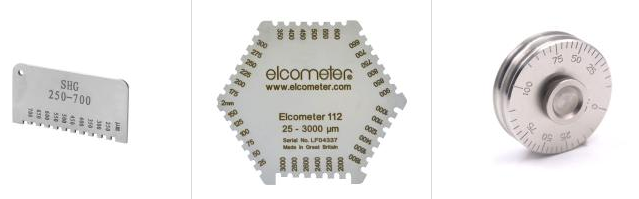
The two gauges used are:
wet film comb
wet film wheel
A wet film comb is a commonly used method for measuring wet film thickness.
Wet film gauges consist of a series of combs at varying distances between the marked point and the baseline.
After placing the comb in the wet coating, the thickness can be measured in microns or mils, which is determined by the number of teeth between the last coated tooth and the subsequent uncoated tooth.
The wet film wheel consists of two outer wheels fixed to a central spindle wheel. Thickness is measured by rolling the wheel at full scale towards the exact zero.
As the roller rolls over the coated substrate, the center roller will contact the coating. The first point of contact on the center wheel determines the wet film thickness.
Both techniques have been used successfully in industry and as part of process control for solid conformal coatings.
Applying the right amount of conformal coating will ensure adequate protection against corrosion or insulation between conductors.

