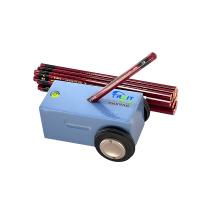
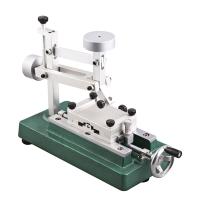
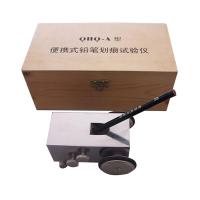
The film industry has used pencil hardness measurements for many years to determine the scratch hardness of a particular coating film. Testing for pencil hardness is straightforward, but results may vary depending on the equipment and procedure used for the test. Every effort should be made to standardize the tests, equipment and techniques followed to obtain comparable results.

What is "Pencil Hardness"?
In the film coating industry, hardness refers to the ability of a given coated surface to resist scratching, gouging or gouging. When expressing the measure of pencil hardness, we use a scale of values that range from 6B, the softest, to 9H, the hardest. Generally, films such as polyesters and polycarbonates fall in the range of B to 4H, depending on whether the film is uncoated or coated, and if coated, what properties are provided by the coating. This value is recorded as the hardest pencil that will not scratch or mar the coated surface.

How to perform a pencil hardness test correctly?
There are two main standardized tests for pencil hardness: ASTM D3363 and JIS K-5600-5-4.
Before starting, you will need the following instruments:
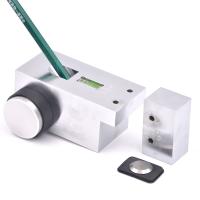
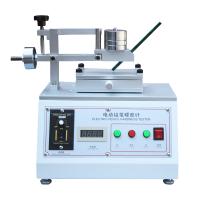
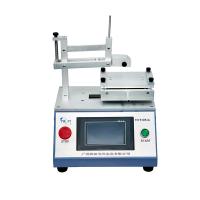
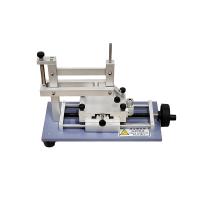
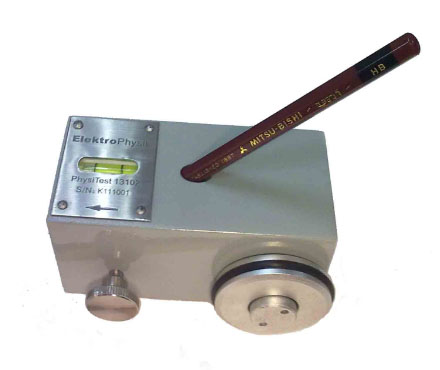
1. Pencil Hardness Tester (ASTM D3363 does allow manual testing without a holder, but for good and consistent results you should use a pencil Hardness Tester)
2. Pencil set specially designed for pencil hardness test
3. 400 mesh sandpaper
4. Pencil sharpener
5. 90° tool
6. Glass plate test surface
First, the film to be tested is placed on the glass plate test surface. You then need to sharpen a pencil of the appropriate hardness for testing. Sharpen the pencil, then load the pencil into the 90° tool and place on 400-grit sandpaper to resurface the test leads. Mount the pencil on the pencil Hardness Tester with an appropriately weighted gram load (Note: This depends on the test you are doing. Various weights can be used for each test. Need to define the weight used in the results). The 45° angle allows the pencil to land gently on the film sample surface. Push the Tester ½" forward. Rotate the pencil 90° to the unused edge, then repeat the test parallel to the first pencil, at least ½" apart.
Check the two strokes to determine whether the surface of the coated film sample is scratched by the lead wire. If neither stroke scratches the surface, the film passes. If one or two strokes scratch the film, the test fails. Repeat the test until failure with different pencils to see the highest pencil hardness the film passes.
Frequently Asked Questions About Pencil Hardness
A common misuse of pencil hardness testing is the various test specification methods used to determine film pencil hardness values. Although there are two standardized specifications , many companies will perform their own testing methods to determine the "pencil hardness" of their films. A common way to change the test is to lower the gram load weight used by the pencil Hardness Tester. The less pressure you put on the pencil, the less chance the lead will scratch the film, resulting in a "higher pencil hardness value". When comparing the pencil hardness of different diaphragms, it is important to check the test procedure to ensure that your comparison methods are consistent.