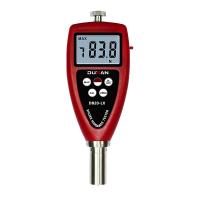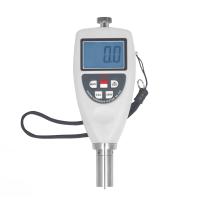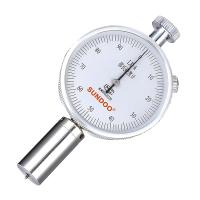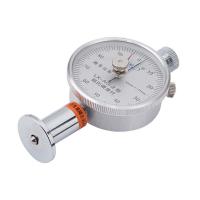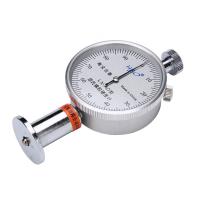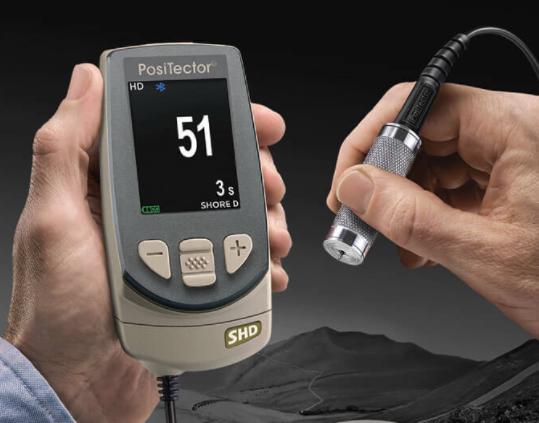
Q1: Does the SHD Shore Hardness Tester require any formal training to use? Do you offer "demo" models?
Won't. Our instruments are designed for simple operation, with easy-to-use menus, full and quick instruction manuals, and helpful videos. In place of the demo model.
Q2: Has the PosiTector SHD Shore Hardness Tester been calibrated at the factory?
The PosiTector SHD is now fully calibrated and ready for measurement. Comes with a long-term certificate of calibration traceable to NIST or PTB, documenting the actual readings your instrument took in our calibration laboratory against standards traceable to national metrology institutes. Beware of "certificates" or "certificates of conformity" offered by competitors. These usually do not include actual instrument readings and are often insufficient for common quality requirements.
The included test block enables the gage operator to quickly verify the correct operation and accuracy of the SHD.
Q3: What is the difference between Shore A and Shore D Hardness Testers?
The PosiTector SHD Shore Durometer measures the indentation hardness of non-metallic materials such as polymers, elastomers and rubber. In the corrosion industry, durometers are commonly used to ensure proper curing of thick coatings and pipe repair materials.
Both PosiTector SHD models look and operate identically, differing only in spring pressure and fingertip shape. This allows two models to accurately measure different hardness ranges:
Shore A (SHDA) - For soft to hard materials such as soft rubber, elastomers, neoprene, silicone, etc.
Shore D (SHDD) - For medium to extra hard materials such as hard rubber, epoxy, hard plastic, PVC, acrylic, etc.
Q4: Can PosiTector SHD measure the hardness of metal?
Shore durometers are designed to measure the indentation hardness of non-metallic materials such as polymers, elastomers and rubber. Almost all metals are not on the Shore hardness scale. The PosiTector BHI Barcol hardness indenter is satisfactory for measuring the hardness of soft metals (aluminum, aluminum alloys, copper, brass, etc.), hard plastics and fiber reinforced plastics.
Q5: Does the PosiTector SHD include a mounting bracket?
No. However, the PosiTectorSHD test stand is available as an optional accessory for the SHD A and SHD D instruments.
Q6: What is the minimum material thickness required for PosiTector SHD measurement?
According to ASTM D2240-15 "Standard Test Method for Properties of Rubber—Durometer Hardness," unless equivalent test results are known to be obtained with thinner samples, the thickness of the sample needs to be at least 6.0 mm (0.24 in). Since field use of Shore durometers may involve testing the hardness of coatings with a measured thickness of less than 6.0 mm, it is important for the operator to know the required coating thickness for a particular application and its expected hardness. Both coating thickness and expected hardness will be specified by the coating manufacturer. Given the wide variety of paints available, DeFelsko was unable to indicate a minimum paint thickness suitable for testing with our PosiTector SHD.
Q7: Can PosiTector SHD measure Rockwell/Brinell/Barcol hardness?
No. The PosiTectorSHD Shore Hardness Tester measures the Shore indentation hardness of non-metallic materials such as polymers, elastomers, and rubber. DeFelsko also makes the PosiTector BHI Barcol durometer, which is an excellent choice for measuring the hardness of soft metals (aluminum, aluminum alloys, copper, brass, etc.), hard plastics, and fiber-reinforced plastics.
Q8: How often should PosiTector probes be recalibrated?
PosiTector probes include a calibration certificate with no expiration or end date. They have no shelf life, so the length of time in the wild is not a good indicator of recalibration intervals. Many organizations with quality programs and recertification programs require annual recalibration, which is a good starting point for most users. DeFelsko recommends that customers determine calibration intervals based on their own experience and work environment. Based on our product knowledge, data and customer feedback, a one-year calibration interval from the date the instrument is placed into service is a good starting point.