Safety Precautions
Knives are sharp objects. Please use with care.
Product Description
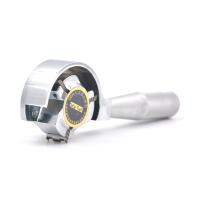
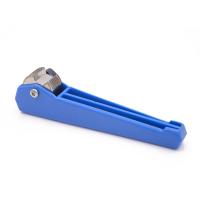
TQC Crosshatch Adhesion Tester CC3000 is used to test the adhesion of dry paint on its substrate through a series of cuts through the coating. Two series of parallel cuts are angled across each other to obtain a pattern of 25 or 100 similar squares. After a brief treatment with a stiff brush or tape for hard substrates, use the tabular sheet to assess the delineated area.
The cutting depth of the TQC paint cross-cutter CC3000 can be adjusted with two ball bearing guides to ensure repeatable results. The depth of the TQC cross-hatch adhesion test kit KIT CC3000 is adjustable to measure coatings up to 250 µm thick.
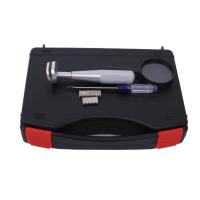
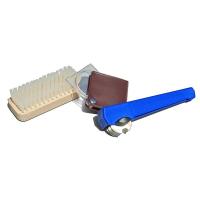
Each TQC cross-hatcher adhesion test kit CC3000 comes with a cutter handle, brush, lighted magnifying glass and a roll of adhesive tape. EN ISO 2409.

Test Methods
1. Make sure the surface to be tested is hard and firm.
2. Make two mutually perpendicular cuts/scratches and use an appropriate knife (depending on coating thickness and substrate) to pull the handle out of the coating and into the substrate, creating a lattice pattern.
3. Lightly brush several times with the included brush along each diagonal of the grid pattern.
4. For hard substrates, the test time can only be extended by sticking tape parallel to a set of cuts on the lattice pattern and pulling it down steadily within 0.5 to 1 second. Rotate at a 60° angle within 5 minutes of application.
5. Carefully inspect the incision area (if needed), using a magnifying glass to classify the test

| level | describe | Appearance of flaking transverse sections (eg 6 parallel sections) |
| 0 | The edges of the crosscuts are perfectly smooth: none of the squares of the lattice are separated | |
| 1 | Small flakes of the coating are peeled off at the intersections of the cuts. The cross section will not be significantly greater than 5% |  |
| 2 | Coating peels off along edges and/or intersections of cuts. Cross-sectional area significantly greater than 5%, but not significantly greater than 15% |  |
| 3 | Coating flakes off in large strips, part or all along the edges of the cut, and/or part or all on different parts of the square. Cross-sectional area significantly greater than 15%, but not significantly greater than 35% |  |
| 4 | The coating flakes off in large strips and/or some squares are partially or completely peeled off along the edges of the cut. Cross-sectional area significantly greater than 35%, but not significantly greater than 65% |  |
| 5 | Any degree of flaking that cannot even be classified by category 4 |
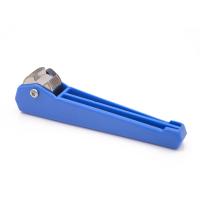
Tip: Always make sure the cutter is sharp and undamaged. The ISO standard recommends changing the tool when the top of the cutting tooth has flattened out by 0.1 mm. Replace the cutter by loosening the small bolt on top with an Allen key. (see picture)

Scope: ISO 2409:2003:
1 mm coating distance up to 60 µm on hard substrates
2 mm coating distances up to 60 µm on soft substrates
Coating spacing from 61 to 120 µm on 2 mm hard and soft substrates
Coating spacing from 121 µm to 250 µm on 3 mm hard/soft substrates
ASTM D3359:
1 mm coating spacing up to 50 µm
1.5 mm Coating Spacing from 50 to 125 µm
maintenance
Despite its robust design, this instrument is precision machined. Never drop or fall
Always clean the instrument after use.
Clean the instrument with a soft dry cloth. Never use any mechanical means such as wire brushes or sandpaper to clean the instrument. Like using aggressive cleaners, this can cause permanent damage.
Always keep the instrument in its case when not in use.