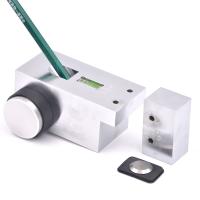
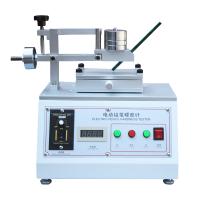
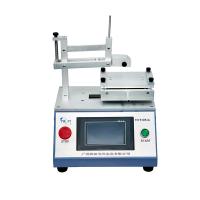
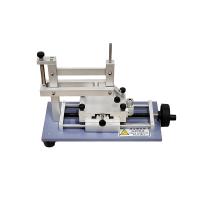
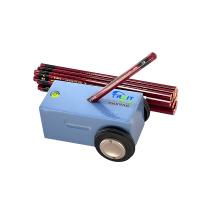
The Wolff Wilborn TQC Pencil Hardness Tester provides an easy way to test the scratch hardness of paint. In this test, pencils with a hardness rating of 8B to 10H were used. The pencil is scratched across the surface at a 45° angle under constant pressure. An optical evaluation is then performed to see which pencil hardness will damage the surface.

Preparation before the test
Use the included sharpener to sharpen a pencil of desired hardness to a 5mm point.
Hold the pencil vertically with the tip down and rub it lightly on a sheet of sandpaper with around 400 grit for a flattened effect.
Hold the pencil in the instrument at a 45-degree angle and close it so that it is level.
Carefully place the pencil Hardness Tester on the substrate to be tested. Test weight depends on model: 5N (500g), 7.5N ( 750g), 10N ( 1000g).
Specific test method
1) Put the pencil Hardness Tester on the wheel between thumb and finger, and push the whole device forward at a speed of 10cm/s.
2) The exact hardness of the pencil is determined through multiple tests.
3) It is recommended to start with a medium soft or medium hard pencil and then return to the correct value. Do not rub any remaining graphite parts into the coating.
4) Clean the surface with a damp sponge or soft cloth. The two strands found were recorded as pencil hardness. For example, a hardness of 3H – 4H means a pencil with 3H still written on the surface, where 4H shows slight scratches on the coating

Instrument Calibration
A certificate of calibration is supplied with the instrument.
Certification and validation should only be performed by accredited laboratories that have the necessary certification tools. We recommend annual calibration.
Maintenance
Despite its sturdy design, this pencil Hardness Tester is precision machined. Never drop or fall
Always clean the instrument after use.
Clean the instrument with a soft dry cloth. Never use any mechanical means such as wire brushes or sandpaper to clean the instrument. Like using aggressive cleaners, this can cause permanent damage.
Always keep the instrument in its case when not in use.
We recommend annual calibration.